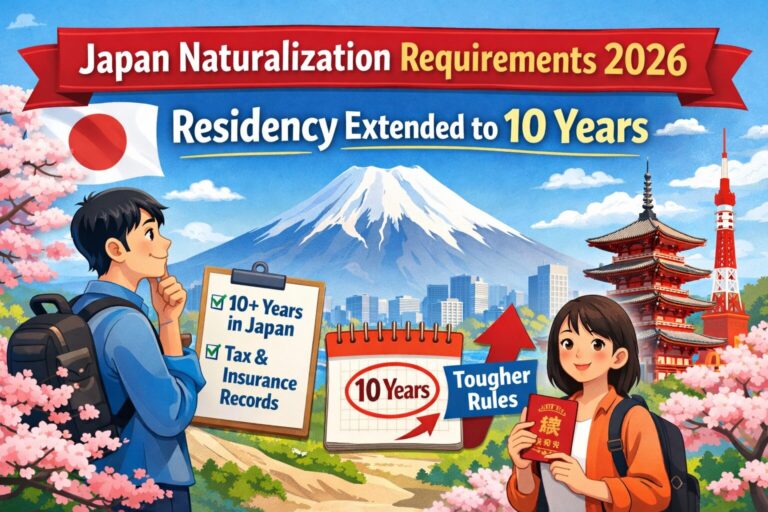
Japan Tightens Naturalization Requirements from April 2026
Residency Requirement Extended to 10 Years – What Foreign Residents Need to Know
The Japanese government has announced a significant policy change regarding naturalization (acquisition of Japanese nationality).
Starting April 1, 2026, the screening process for naturalization applications will become stricter, particularly regarding the required period of residence in Japan.
This change is highly relevant for:
- Foreign residents currently considering naturalization
- Individuals planning to move to Japan long-term
- Applicants who have already submitted their naturalization applications
This article explains the new requirements, practical implications, and key points you must understand.
- 1 Key Change: Residency Requirement Extended to 10 Years
- 2 Why Is Japan Tightening Naturalization Requirements?
- 3 Additional Changes: Tax and Social Insurance Records
- 4 Does This Apply to Existing Applications?
- 5 Are There Exceptions?
- 6 Current Statistics (Reference)
- 7 Practical Impact for Foreign Residents
- 8 Key Takeaways
- 9 Conclusion
- 10 📩 Contact (General Inquiries & Communication)
Key Change: Residency Requirement Extended to 10 Years
Under the previous standard, applicants were generally required to have lived in Japan for at least 5 years.
However, under the new operational policy:
- The required period is now 10 years of continuous residence (in principle)
Important clarification:
This is not a change in the law itself, but a change in how the Ministry of Justice applies (interprets) the requirements.
In practice, authorities had often already expected longer residence periods, but this update makes it explicit and consistently enforced.
Why Is Japan Tightening Naturalization Requirements?
The change is part of a broader government policy on foreign residents.
One key reason:
- Permanent residency (PR) generally requires about 10 years of residence
- Naturalization grants full citizenship rights, including voting rights
There has been criticism that:
Naturalization had effectively been easier to obtain than permanent residency
The government aims to align the standards more closely.
Additional Changes: Tax and Social Insurance Records
The requirements for proving financial and legal compliance have also been strengthened.
Previously:
- Tax and social insurance records for about 1 year
Now:
- Tax payment records: 5 years
- Social insurance records: 2 years
This aligns naturalization screening with permanent residency standards.
Does This Apply to Existing Applications?
Yes. This is a critical point.
- Even if you applied before April 1, 2026
- If your application is still under review
👉 The new stricter criteria will be applied
This means:
- Some applicants may face additional scrutiny
- Longer residence history may be required than originally expected
Are There Exceptions?
Yes. The 10-year requirement is not absolute.
Exceptions may apply in cases such as:
- Spouses of Japanese nationals
- Individuals with significant contributions to Japan
- Special humanitarian or public interest considerations
However, these are evaluated case-by-case, and approval is not guaranteed.
Current Statistics (Reference)
According to recent data:
- Applications (2025): 14,103
- Approved: 9,258
The Ministry of Justice has indicated that:
The number of approvals is not expected to decrease significantly
This suggests that many approvals already required longer residence periods in practice.
Practical Impact for Foreign Residents
1. Long-Term Planning Is Now Essential
If you are considering naturalization:
- You should expect a 10+ year timeline
- Early planning is critical
2. Tax and Insurance Compliance Is More Important Than Ever
You must maintain:
- Continuous tax payments
- Proper enrollment in social insurance
Any gaps may negatively affect your application.
3. Short-Term Strategies May No Longer Work
Previously:
- Some applicants aimed for naturalization after 5–6 years
Now:
- This approach is significantly less viable
Key Takeaways
- Residency requirement: 5 → 10 years (in principle)
- Applies to pending applications
- Tax and insurance checks significantly expanded
- Exceptions still exist but are limited
Conclusion
Japan’s naturalization process is becoming more structured and consistent with other immigration statuses.
For foreign residents, the message is clear:
Naturalization is now a long-term commitment requiring stability, compliance, and integration into Japanese society.
If you are considering applying, it is advisable to:
- Review your residence history
- Confirm tax and insurance records
- Seek professional guidance early
📩 Contact (General Inquiries & Communication)
For updates on an ongoing case, document submission, or other general inquiries, you may contact us through the tools below.
⚠️ Please note that we do not answer visa, residency status, licensing, apostille, or other consultation-related questions through this Contact section.
If you would like to receive advice or guidance, please apply through our paid consultation page.
👉 Click here to book a consultation (Consultation Page)
Contact |
E-mail |
LINE |
WhatsApp |
小红书 |
WeChat |
Office Name: Trust Administrative Scrivener Office
Email: info@trust-gyosei.com