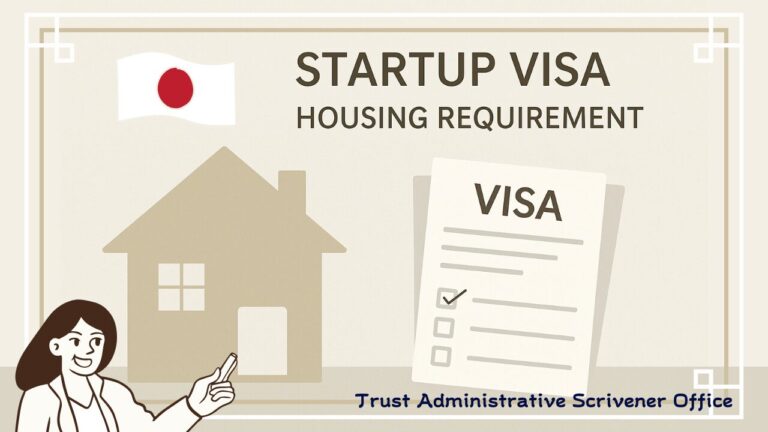
When people compare Japan’s Startup Visa and the Business Manager Visa, they often focus on things like capital, the business plan, or hiring requirements.
In real life, however, one of the earliest and biggest challenges is often much simpler:
Securing a place to live (housing).
This article explains the housing requirement and the practical issues applicants frequently face, based on real-world experience with Fukuoka City and Kitakyushu City Startup Visa cases.
(Note: requirements and operational practice can differ by municipality and may change over time.)
- 1 The Startup Visa may require you to prove housing for a fixed period
- 2 Why “proof of 6 months’ housing” is requested (practical understanding)
- 3 Even if “an application form is acceptable,” applying can be extremely difficult
- 4 “Pay 6 months upfront” is sometimes suggested—but it can be risky
- 5 Weekly/monthly furnished rentals are not always a simple solution
- 6 Why hotels / short-stay accommodations may be viewed unfavorably
- 7 Staying with friends or relatives can be a realistic option (in some cases)
- 8 A key difference from the Business Manager Visa
- 9 Conclusion: Treat housing as a top priority when considering the Startup Visa
- 10 Our support
- 11 📩 Contact (General Inquiries & Communication)
The Startup Visa may require you to prove housing for a fixed period
Under the Startup Visa framework, applicants may be asked to show evidence of their residence after landing in Japan (or after changing status) for a certain period in advance.
Fukuoka City (example)
Fukuoka City’s guidance includes documents that clarify the applicant’s housing for one year after landing / status change, such as:
-
A copy of the lease contract
-
A copy of a rental application
-
A copy of a lease estimate/quotation, etc.
Kitakyushu City (example)
Kitakyushu City’s materials generally require documents that clarify housing for six months after landing, such as:
-
A copy of the lease contract
-
A copy of a rental application
-
An occupancy application, etc.
Why “proof of 6 months’ housing” is requested (practical understanding)
In practice, this type of document is generally understood to be requested to confirm whether the applicant has an environment that makes it realistic to:
-
stay for a certain period after arrival,
-
prepare for launching the business in the city (or nearby),
-
and reach the first renewal of the residence status.
This explanation is based on practical experience and communication in actual cases. However, review standards and decisions may differ by municipality and by case.
Even if “an application form is acceptable,” applying can be extremely difficult
Even when the rules say a rental application / occupancy application can be used, many applicants find that submitting an application itself is very difficult.
Why?
If you are:
-
not living in Japan yet,
-
do not have a Residence Card,
-
do not have a COE (Certificate of Eligibility),
many real estate agencies and property management companies will simply say they cannot accept the application.
Inquiries to multiple real estate companies often result in responses like:
-
“No Residence Card = we cannot accept the application.”
-
“Applicants who do not live in Japan cannot apply.”
-
“Our management company’s rules do not allow overseas residents.”
Guarantor requirements can be another major barrier
In some cases, a real estate company may require:
-
a guarantor living in Japan (and sometimes preferably Japanese),
-
and also enrollment in a separate rent guarantee company.
For many Startup Visa applicants—especially those with no contacts in Japan—securing a guarantor can be practically impossible.
Even if a landlord personally seems open to it, when a property management company is involved, their internal rules and screening standards usually take priority, making it difficult to proceed based on the landlord’s preference alone.
“Pay 6 months upfront” is sometimes suggested—but it can be risky
Some companies may propose conditions such as:
-
“We may consider it if you pay 6 months upfront,”
-
“No refunds even if you cancel,” etc.
However, because visa approval is not guaranteed until after filing and review, this kind of arrangement can create significant financial risk for the applicant.
Weekly/monthly furnished rentals are not always a simple solution
Weekly/monthly furnished apartments can be helpful, but you still need to check the contract conditions carefully. Terms vary widely by company:
-
Some require 6 months or 1 year prepaid
-
Some may be non-refundable even if you cancel early
-
Some allow monthly renewals and are more flexible
Family cases are even harder because larger units are limited. In our practical experience, supporting housing arrangements for a family (multiple members) required substantial coordination before the Startup Visa application could proceed.
Why hotels / short-stay accommodations may be viewed unfavorably
Hotels or very short-term stays may be seen as problematic because:
-
it is difficult to show continuity of residence, and
-
it may only prove residence for 1–2 months, not the required period.
As a result, it may be more likely to be evaluated unfavorably for Startup Visa purposes.
Important note: The treatment of hotels/short-stay options (including “minpaku”) can differ by municipality and by the details of your documentation and plan. Final evaluation is made on a case-by-case basis.
Staying with friends or relatives can be a realistic option (in some cases)
If you have friends or relatives in Japan, and you can reasonably explain that:
-
you can live there for a certain period, and
-
it functions as a stable base while preparing your startup,
it may be a more realistic path.
That said, acceptance depends on municipality practice and the details of the individual case.
A key difference from the Business Manager Visa
This housing requirement is one of the major practical differences between the Startup Visa and the Business Manager Visa.
With the Business Manager Visa, housing is generally not treated as a mandatory requirement at the application stage in the same way. After COE issuance and entry to Japan, the applicant can typically plan and secure long-term housing based on their real situation and business preparation progress.
As a result, compared to the Startup Visa, the initial housing hurdle before filing is often lower.
Conclusion: Treat housing as a top priority when considering the Startup Visa
If you are considering the Startup Visa, housing should be planned as early as possible, in parallel with your business plan and budget.
It is easy to overlook this when reading制度 explanations, but in practice, housing can become the biggest early obstacle.
(This article reflects practical experience with Fukuoka City and Kitakyushu City cases. Requirements and operational practice may vary by municipality and may change over time. Always confirm the latest guidance and consider your case individually.)
However, this approach is not accepted in all cases. Whether such documentation can be used, and the specific form it may take, must always be confirmed in advance with the relevant municipal office.
👉 Read the Japanese version here
Our support
Our office handles a large number of Startup Visa and Business Manager Visa cases for foreign clients.
In particular, we frequently support applicants who:
-
have no local partner or contacts in Japan,
-
need to prepare before arrival,
-
are concerned about housing and office setup while staying compliant with the visa process.
We focus not only on explaining the rules, but also on organizing the process step by step, identifying practical bottlenecks early, and moving the case forward in a realistic way.
📩 Contact (General Inquiries & Communication)
For updates on an ongoing case, document submission, or other general inquiries, you may contact us through the tools below.
⚠️ Please note that we do not answer visa, residency status, licensing, apostille, or other consultation-related questions through this Contact section.
If you would like to receive advice or guidance, please apply through our paid consultation page.
👉 Click here to book a consultation (Consultation Page)
Contact |
E-mail |
LINE |
WhatsApp |
小红书 |
WeChat |
Office Name: Trust Administrative Scrivener Office
Email: info@trust-gyosei.com