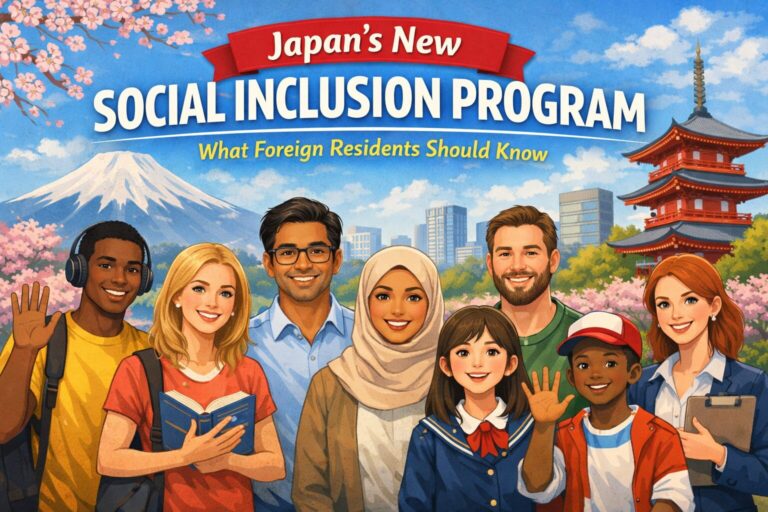
Japan is changing.
There are more foreign workers, more international families, and more children with roots outside Japan than ever before. At the same time, social media is full of confusing claims:
-
“Foreigners are making Japan less safe.”
-
“Foreigners are taking advantage of social security.”
-
“Foreigners are driving up housing prices.”
Many of these claims are emotionally powerful but statistically weak.
In this article, I would like to:
-
explain the new “social inclusion” program the Japanese government is considering;
-
show what data actually tells us about crime, social security and education;
-
share my own perspective as both an immigration administrative scrivener (gyoseishoshi) and a Japanese language teacher.
- 1 Japan’s reality: more foreign workers, more families, more children
- 2 What is Japan’s planned “Social Inclusion Program”?
- 3 Crime and safety: what do the numbers actually say?
- 4 Social security and health insurance: “free-riding” or support base?
- 5 Housing, land, and foreign investment: should you worry?
- 6 Children with foreign roots: language support and education gaps
- 7 My view as an administrative scrivener and Japanese teacher
- 8 Practical advice for foreign residents and future migrants
- 9 FAQ: Common Questions About Foreign Residents, Language, and the New Program
- 9.1 Q1. Will the Social Inclusion Program be mandatory to get or renew my visa?
- 9.2 Q2. I speak English but not Japanese. Is it still realistic to live in Japan?
- 9.3 Q3. Are foreigners making Japan less safe?
- 9.4 Q4. Are foreigners using Japanese health insurance for free?
- 9.5 Q5. Will my child get Japanese language support at school?
- 9.6 Q6. My child was a top student in our home country but now struggles in a Japanese school. What can I do?
- 9.7 Q7. How can I prepare before coming to Japan?
- 9.8 Q8. Where can I find Japanese language classes?
- 10 Final Thoughts
- 11 Fukuoka Global Hub — Cross Border Support —
- 12 📩 Contact (General Inquiries & Communication)
Japan’s reality: more foreign workers, more families, more children
According to Japanese government data, the number of foreign workers in Japan reached around 2.3 million as of October 2024, almost three times more than ten years earlier.
They work in many industries:
-
wholesale & retail
-
manufacturing (food, cars, etc.)
-
accommodation and restaurants
-
construction
-
and also in more “highly skilled” jobs than many people imagine.
In parallel, Japan’s inbound tourism has broken records: in 2024, about 36.9 million international visitors came to Japan, spending over 8 trillion yen – tourism is now Japan’s second-largest export sector after automobiles.
This means:
-
more foreign workers in regional cities and small towns;
-
more foreign residents bringing their spouses and children;
-
more contact – and sometimes more friction – between Japanese communities and new neighbors.
The government now sees language and integration not only as a “nice to have” but as a national policy issue.
What is Japan’s planned “Social Inclusion Program”?
The government and ruling parties are now discussing a new framework tentatively called the “Social Inclusion Program” (社会包摂プログラム, provisional name) for medium- to long-term foreign residents.
Although the final details are not decided yet, the current ideas include:
Main components
-
Japanese language and life rules courses
Classes to learn:-
basic Japanese for daily life;
-
rules about trash, noise, traffic, taxes, etc.;
-
how local government and social systems work.
-
-
“Pre-school” classes for foreign children
Before entering elementary or junior high school, children could join a pre-school program (also a provisional idea) to:-
learn basic Japanese;
-
practice Japanese school routines (indoor shoes, cleaning, lunch duty, homework, etc.);
-
reduce culture shock when they join a regular class.
-
-
National guidelines for Japanese language education
Many cities already provide Japanese classes, but the quality and style are very different. The government wants to create guidelines so that local governments have a shared standard when they support foreign residents.
Connection with immigration (visa) screening
One important point:
The government is considering including participation in these programs as one of the factors in residence examinations (for example, when you renew your status or apply for a longer period).
This does not necessarily mean:
“If you don’t attend, your visa will be refused.”
But in the future, it is very possible that:
-
joining language / integration programs will work as a positive factor,
-
especially for people who wish to stay long-term, obtain permanent residence, or change to a more stable status.
As an immigration lawyer-type professional, I see this as:
“Japan is moving from a purely economic immigration policy (‘We only need your labor’)
to a community integration policy (‘We need you as neighbors and future citizens’).”
This shift is important for you if you plan to build a life, raise children, or start a business in Japan.
Crime and safety: what do the numbers actually say?
One of the strongest fears in Japanese society is:
“If foreigners increase, crime will increase and Japan will be less safe.”
However, the Japanese government’s own data shows a different picture.
-
The number of foreign residents has increased compared with the mid-2000s.
-
At the same time, the number of criminal cases involving foreign residents has decreased in the long term.
-
If we look at foreigners who are settled in Japan (permanent residents, spouses of Japanese, etc.), the number of criminal cases per 1,000 people has gone down by more than half compared with 2005 (using Justice Ministry & immigration statistics).
In addition:
-
The overall share of foreigners among people arrested for Penal Code offences is around a few percent;
-
and the proportion of foreign suspects who are actually prosecuted (brought to court) is higher than for Japanese suspects.
In other words, the idea that “foreign criminals are not prosecuted” is not supported by the data.
From my viewpoint as a gyoseishoshi:
-
The majority of my foreign clients are very careful to follow Japanese rules because they know their residence status depends on it.
-
They also often feel watched, which makes them more nervous and conservative in daily life than many Japanese imagine.
This does not mean “foreigners never commit crime”.
But the simple sentence:
“Foreigners increase → crime increases”
is not supported by official statistics and is mainly a fear-based narrative, not a data-based conclusion.
Social security and health insurance: “free-riding” or support base?
Another common claim online is:
“Foreigners are using Japanese health insurance and social security for free.”
Let’s look at national health insurance (国民健康保険, NHI) data.
According to official materials from the Cabinet Secretariat and the Ministry of Health, Labour and Welfare:
-
Foreigners are about 4.0% of all NHI members (around 970,000 people).
-
But foreign residents account for only 1.39% of total NHI medical costs (about 124 billion yen) and 1.21% of high-cost medical benefit payments.
This means:
-
Foreigners pay premiums and taxes, but
-
their medical spending is smaller than their share of membership, mainly because many are young and relatively healthy.
In simple terms:
On average, foreign NHI members are supporting the system more than they are using it.
From my professional experience:
-
Many clients struggle to understand Japanese insurance rules, letters from the city office, and payment deadlines.
-
Some fall behind in payments not because they want to cheat, but because the system is hard to understand in a foreign language.
This is exactly why a social inclusion program with clear explanations in “easy Japanese” and other languages is necessary – it protects both foreign residents and the Japanese social security system.
Housing, land, and foreign investment: should you worry?
Media sometimes reports that:
-
resort land near ski areas,
-
apartments in big cities, or
-
commercial buildings in downtown Tokyo
are being bought by foreign investors and that this is pushing up prices.
Yes, foreign capital is one factor in some areas, especially resorts and central business districts. But large financial institutions note that, for normal residential condominiums in Tokyo’s 23 wards, the share of units purchased by foreign buyers is still relatively limited overall, although higher in certain central districts.
The Japanese government has already created a Land Use Regulation Law to control land around critical facilities such as Self-Defense Force bases and nuclear plants. For other areas, discussion about new rules is still ongoing.
For ordinary foreign residents who:
-
rent an apartment, or
-
buy a normal home for living,
the main issues are still:
-
language barriers when signing contracts;
-
misunderstandings about deposits, key money, and guarantors;
-
discrimination in rental markets (“no foreigners”).
These are serious problems, but they are different from the “foreign investor pushes up land price” narrative.
Children with foreign roots: language support and education gaps
One of the most important – and least visible – issues is education for children with foreign roots.
According to a survey by the Ministry of Education (MEXT), in 2023 there were about 69,123 students in public elementary, junior high and high schools who needed Japanese language support, almost double the number in 2012.
At the same time:
-
Another survey found over 8,000 foreign-national children who might not be attending any school at all.
-
Among high-school-age students needing Japanese support, drop-out rates are higher, and the proportion who go on to university or vocational school is much lower than for Japanese students.
This is not just an “immigration issue”.
It is a future labor force and social inclusion issue for Japan as a whole.
A promising model: “initial Japanese instruction classes”
Some Japanese municipalities are already trying innovative approaches.
For example, the city of Nishio in Aichi Prefecture runs a program often referred to as a “Japanese initial instruction class”:
-
Newly arrived children attend a special classroom for about three months.
-
They learn:
-
basic Japanese;
-
school routines (indoor shoes, cleaning, lunch duty, how to submit homework, etc.);
-
introduction to main subjects in simple Japanese.
-
-
After returning full-time to their regular school, staff from the program continue to visit schools and support homeroom teachers.
Support is available in multiple languages, often with bilingual staff and “easy Japanese” materials.
Children who attended such programs are described as:
-
more confident;
-
more expressive;
-
more likely to continue education and dream about future careers.
From my Japanese-teacher point of view, I strongly believe:
“Early and structured Japanese support is an investment in Japan’s future.”
We are not just teaching a language – we are protecting children’s mental health, social participation and economic potential.

My view as an administrative scrivener and Japanese teacher
I stand in two positions every day:
-
As an administrative scrivener (gyoseishoshi), I support visa, status of residence, and company establishment.
-
As a Japanese language teacher, I teach learners who want to understand Japanese society more deeply.
From this double perspective, I see three main challenges and three opportunities.
Challenges
-
Information gap
-
Important information is often only in Japanese, in complex bureaucratic language.
-
Foreign residents rely on social media or friends instead of official sources.
-
-
Fragmented support
-
Some cities have excellent Japanese classes and consultation centers; others have almost none.
-
Children’s support, adult language classes, and visa advice are often not connected.
-
-
Fear and mistrust
-
Some Japanese people fear “foreign crime” or “social security abuse” because they only hear extreme stories.
-
Some foreigners feel constantly judged and stop interacting with Japanese neighbors.
-
Opportunities
-
Social inclusion program as a “bridge”
If well designed, the new program can connect:-
language classes,
-
school support,
-
life guidance (rules, taxes, insurance), and
-
immigration procedures.
-
-
Use of “easy Japanese” and multilingual support
When city offices and schools use:-
simpler Japanese,
-
visual materials, and
-
bilingual support staff,
misunderstandings and late payments or mistakes can be reduced dramatically.
-
-
Pre-arrival education
If online materials and curricula are ready, future residents and their children can start learning before coming to Japan.
This would make the first months in Japan much less stressful.
As professionals, we also must adjust.
For example, I am considering:
-
linking consultation services more clearly with Japanese-language guidance;
-
providing materials that explain visa requirements in easy Japanese and English;
-
creating more content about how to prepare children for Japanese schools.
Practical advice for foreign residents and future migrants
Here are some concrete steps you can take, whether you are already in Japan or planning to come.
If you already live in Japan
-
Join local Japanese classes
-
Ask your city hall about 日本語教室 (nihongo kyōshitsu) or “Japanese language class”.
-
Many are low-cost or free.
-
-
Learn the “hidden curriculum” of Japanese life
-
Garbage rules, neighborhood associations, school routines, tax and pension systems.
-
If you have children, ask the school about Japanese support and any special classes.
-
-
Keep your residence status stable
-
Pay taxes and insurance premiums on time.
-
Report address changes properly.
-
Keep records of your activities, income, and participation in community life.
-
-
Use “easy Japanese” resources
-
Look for websites and flyers labeled やさしい日本語 (“easy Japanese”).
-
They are designed to be easier to read if your Japanese level is not high.
-
If you are planning to move to Japan
-
Start Japanese NOW – even simple phrases help
-
Focus first on listening and speaking for daily life.
-
Learn hiragana and katakana if possible.
-
-
Research your visa route carefully
-
Business Manager, Skilled Labor, Highly Skilled, Specified Skilled Worker, Student, etc.
-
Each status has different rules for family members, work, and length of stay.
-
-
Think about your children’s education early
-
If you have children, check what language they use at home, what school options exist, and whether Japanese support classes are available in your target city.
-
-
Prepare documents and savings
-
The new “training/employment” style systems give more chances to upgrade status, but you must still meet financial and skill conditions.
-
FAQ: Common Questions About Foreign Residents, Language, and the New Program
Q1. Will the Social Inclusion Program be mandatory to get or renew my visa?
A. At this stage, details are not fixed. The current idea is to consider participation as one positive factor in residence examinations, not as an absolute requirement.
However, in the long term, I expect that:
-
attending language and integration courses will strengthen your case,
-
especially for long-term residence, permanent residence, or status upgrades.
Q2. I speak English but not Japanese. Is it still realistic to live in Japan?
A. It is possible, especially in big cities, but your life will be much easier and safer if you learn at least basic Japanese:
-
to read city hall letters,
-
to understand school notices,
-
to talk to doctors,
-
to handle emergencies.
The new program will likely increase access to Japanese classes, but your own effort will still be crucial.
Q3. Are foreigners making Japan less safe?
A. Official statistics do not support the idea that more foreigners = more crime.
-
The number of foreign residents has increased,
-
but the number of criminal cases involving foreign residents has decreased over the long term,
-
and the prosecution rate for foreign suspects is actually higher than for Japanese suspects.
There are crimes by foreigners, just as there are crimes by Japanese people, but the image of a “foreign crime wave” is exaggerated.
Q4. Are foreigners using Japanese health insurance for free?
A. No.
In national health insurance (NHI):
-
Foreigners are about 4% of all members,
-
but only 1.39% of total medical costs and 1.21% of high-cost medical benefits.
This means that, on average, foreign residents are not heavy users of the system.
Many are young workers who pay into the system but use it less than older Japanese members.
Q5. Will my child get Japanese language support at school?
A. It depends on the city, but the situation is improving.
-
More and more cities now offer initial Japanese instruction classes, special support rooms, or visiting teachers.
-
The government estimates that over 69,000 students needed Japanese language support in 2023, and this number is rising.
When you enroll your child:
-
Tell the school honestly about your child’s language background.
-
Ask what kind of Japanese support is available.
-
If necessary, ask the city hall education office for help.
Q6. My child was a top student in our home country but now struggles in a Japanese school. What can I do?
A. This is very common and not a sign that your child is “slow”.
They are:
-
learning a new language,
-
adapting to a new culture, and
-
trying to understand new subjects at the same time.
You can:
-
ask the school about Japanese support classes;
-
support your child’s first language at home (reading, writing, talking);
-
look for community Japanese classes designed for children;
-
consider counseling if your child seems depressed or withdrawn.
Q7. How can I prepare before coming to Japan?
A. Some ideas:
-
Learn basic Japanese phrases and hiragana/katakana.
-
Watch videos about Japanese daily life and school culture.
-
If you have children, find resources that teach Japanese for kids.
-
Collect important documents (birth certificates, diplomas, medical records) and make certified translations if needed.
Q8. Where can I find Japanese language classes?
A. Try:
-
your city hall (look for 国際交流課, 多文化共生, or 日本語教室);
-
local NPOs and international associations;
-
online Japanese teachers (including teachers who understand visa and life issues, not only grammar).
Final Thoughts
Japan is entering a new phase.
It is no longer a country where foreigners are rare guests – they are essential workers, neighbors, and classmates.
The planned Social Inclusion Program is not perfect yet. There are risks:
-
If badly designed, it might become just another bureaucratic burden.
-
If implemented only on paper, nothing will change.
But if we use this moment wisely:
-
foreign residents can receive clearer information and better language support;
-
Japanese society can base its opinions on data, not fear;
-
and children with foreign roots can grow up as confident members of Japanese society, not as outsiders.
As a gyoseishoshi and a Japanese language teacher, I hope to continue helping foreign residents:
-
understand the rules and systems, and
-
find their own voice in Japanese.
And beginning in 2026, I will take one step further.
Fukuoka Global Hub — Cross Border Support —
Coming Soon in 2026

I am preparing to launch a new initiative in the Hakata area of Fukuoka —
a place where immigration support, Japanese language education, and community exchange come together.
🌏 Visa & Startup Support
A professional administrative scrivener desk specialized in visas, business setup, and cross-border procedures.
📖 Japanese Language Learning Space
Lessons, workshops, and extensive-reading events led by an experienced Japanese teacher.
🤝 Community & Cultural Exchange
A welcoming environment where residents from different countries can meet, learn, and build connections.
📍 Location: Hakata Station Area — Opening in 2026
Updates will be shared on this website.
Through this hub, I hope to create a place where:
-
foreign residents can receive trustworthy support,
-
Japanese and non-Japanese neighbors can learn from each other, and
-
everyone — regardless of nationality — can participate in building a more inclusive future for Fukuoka.
If you are living in Japan now or planning to move here,
I invite you to see yourself not only as a guest,
but as a partner in shaping Japan’s next chapter.
Keiko Utsunomiya
📩 Contact (General Inquiries & Communication)
For updates on an ongoing case, document submission, or other general inquiries, you may contact us through the tools below.
⚠️ Please note that we do not answer visa, residency status, licensing, apostille, or other consultation-related questions through this Contact section.
If you would like to receive advice or guidance, please apply through our paid consultation page.
👉 Click here to book a consultation (Consultation Page)
Contact |
E-mail |
LINE |
WhatsApp |
小红书 |
WeChat |
Office Name: Trust Administrative Scrivener Office
Email: info@trust-gyosei.com