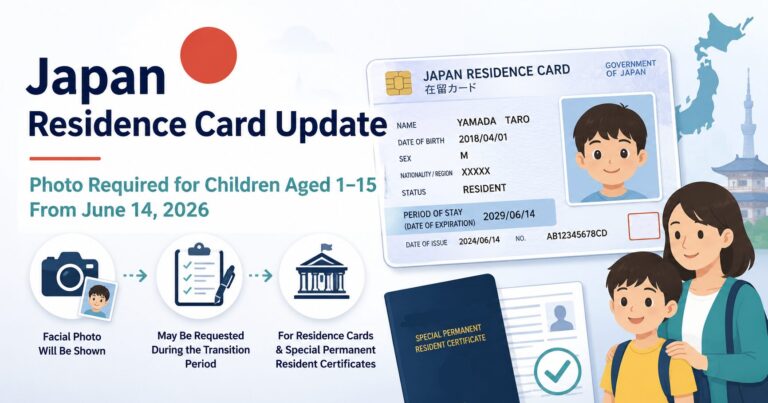
Japan’s Immigration Services Agency has announced an important update regarding the issuance of new-format residence cards and special permanent resident certificates.
From June 14, 2026, the amended Immigration Control and Refugee Recognition Act and related laws will come into force. As part of this change, the format of the Residence Card and Special Permanent Resident Certificate will be revised.
One of the key practical changes is that children aged 1 or older and under 16 will newly have their facial photo displayed on their residence card or special permanent resident certificate.
This article explains what foreign residents, parents, guardians, and applicants should know before submitting applications around the transition period.
- 1 What Will Change from June 14, 2026?
- 2 Who Is Affected?
- 3 Applications Filed Before June 14, 2026 May Still Be Affected
- 4 What About Online Applications?
- 5 Important Note: The Photo May Not Appear If the Card Is Issued Before June 14, 2026
- 6 Special Permanent Resident Certificates
- 7 Practical Checklist for Parents and Guardians
- 8 Why This Matters
- 9 Conclusion
- 10 Need Help with a Residence Application in Japan?
- 11 Need professional advice?
What Will Change from June 14, 2026?
Until now, children under 16 were generally not required to submit a facial photo for residence card-related applications.
However, under the new card format, children aged 1 to 15 will be required to have a facial photo on their residence card or special permanent resident certificate.
This means that, after the new system begins, a facial photo will generally be necessary for:
- children aged 1 or older and under 16;
- applications or notifications that involve the issuance of a residence card;
- applications or notifications that involve the issuance of a special permanent resident certificate.
The change is related to the amended Immigration Control and Refugee Recognition Act and related laws, which were enacted as Act No. 59 of 2024 and are scheduled to come into force on June 14, 2026. The broader amendment includes revisions to the residence card system and the special permanent resident certificate system.
Who Is Affected?
This update mainly affects children who will be aged 1 to 15 at the time the new-format card is issued.
In particular, parents and guardians should pay attention if they are preparing any of the following procedures for a child:
- application for extension of period of stay;
- application for change of status of residence;
- application for acquisition of status of residence;
- notification or application involving issuance of a residence card;
- application or notification involving a special permanent resident certificate.
The key point is not only the application date, but also when the residence card or certificate is expected to be issued.
Applications Filed Before June 14, 2026 May Still Be Affected
A particularly important point is the transition period before June 14, 2026.
Even if an application is filed before June 14, 2026, if the residence card is expected to be issued on or after June 14, 2026, the Immigration Services Agency may ask for a facial photo for a child aged 1 to 15.
According to the Immigration Services Agency’s announcement, for applications submitted at a regional immigration office before June 14, 2026, applicants may be asked to voluntarily submit a facial photo if the child is aged 1 to 15 and the residence card is expected to be issued on or after June 14, 2026.
In other words, families should not assume that a photo is unnecessary simply because the application is submitted before the enforcement date.
What About Online Applications?
For online applications, the handling is slightly different during the transition period.
Under the current online residence application system, applications for children under 16 use a special “photo not required” data file in the facial photo attachment field.
However, from June 14, 2026, children aged 1 or older will generally need to submit facial photo data.
For applications submitted before June 14, 2026 where the residence card will be issued on or after that date, applicants cannot submit the child’s photo through the normal “facial photo attachment field” in the current system.
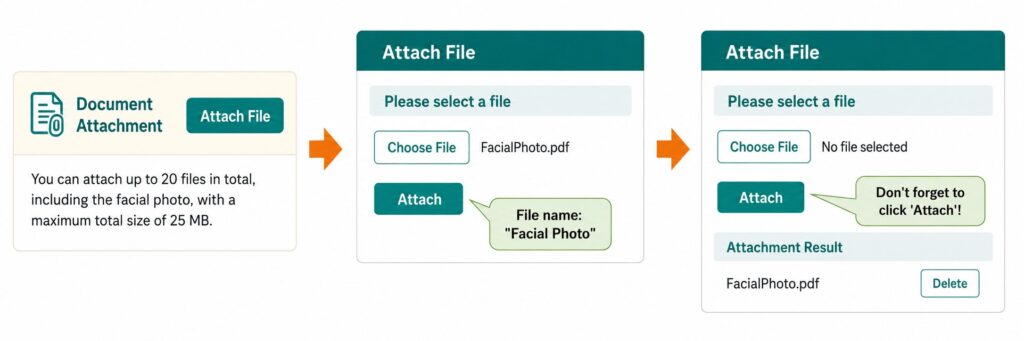
Instead, the Immigration Services Agency explains that the photo should be prepared according to the official photo guidance, converted into PDF format, named “顔写真” / “facial photo,” and uploaded through the “document attachment field” of the online system.
In some already-submitted cases, Immigration may also request the facial photo later as an additional document.
Important Note: The Photo May Not Appear If the Card Is Issued Before June 14, 2026
Even if a facial photo is submitted before June 14, 2026, the photo may not appear on the residence card if the card is issued before the new system begins.
This is because the new photo display requirement applies to the new-format card system beginning on June 14, 2026.
Therefore, applicants should understand that submitting a photo during the transition period does not always mean the photo will be printed on the card.
Special Permanent Resident Certificates
The announcement also covers special permanent resident certificates.
For applications or notifications involving the issuance of a special permanent resident certificate submitted between June 10 and June 13, 2026, a facial photo must be submitted if the person will be aged 1 or older as of June 14, 2026.
Even for applications or notifications submitted before that period, applicants may still be asked to submit a facial photo depending on the timing and expected issuance of the certificate.
Practical Checklist for Parents and Guardians
If you are preparing a residence-related application for a child, it is advisable to check the following points in advance:
- Is the child aged 1 or older and under 16?
- Will the residence card or special permanent resident certificate be issued on or after June 14, 2026?
- Are you filing the application at the immigration office or through the online system?
- If applying online, do you need to upload the photo as a PDF through the document attachment field?
- Have you prepared a photo that meets the Immigration Services Agency’s official photo requirements?
Because this is a transitional measure, the actual handling may depend on the application date, expected issuance date, and instructions from the immigration office.
Why This Matters
This change may seem small, but it can affect the preparation of immigration applications for families with young children.
If a required facial photo is missing, Immigration may later ask for additional documents. This can slow down the examination process or delay issuance of the residence card.
For this reason, applicants should check the latest official guidance and prepare the child’s photo in advance when there is a possibility that the new-format card will be issued on or after June 14, 2026.
Conclusion
From June 14, 2026, Japan’s new-format residence cards and special permanent resident certificates will display facial photos for children aged 1 to 15.
Even before that date, applicants may be asked to submit a facial photo if the card or certificate is expected to be issued after the new system begins.
For families applying around this transition period, it is important to confirm the latest Immigration Services Agency guidance and prepare the required photo carefully.
Need Help with a Residence Application in Japan?
Trust Administrative Scrivener Office supports foreign residents and their families with residence status applications in Japan.
If you are unsure whether your child’s application requires a facial photo, or if you need support preparing immigration documents, please contact us through our consultation page.
PROFESSIONAL SUPPORT
Need professional advice?
If you need individual advice regarding Japanese visas, residence status, company setup, permits, or official document procedures, please book a paid consultation.
We do not provide individual case assessments through free blog comments, general contact forms, or social media messages.
All consultations require advance booking and advance payment.
Trust Administrative Scrivener Office
Based in Kitakyushu, Fukuoka, Japan | Online consultations available