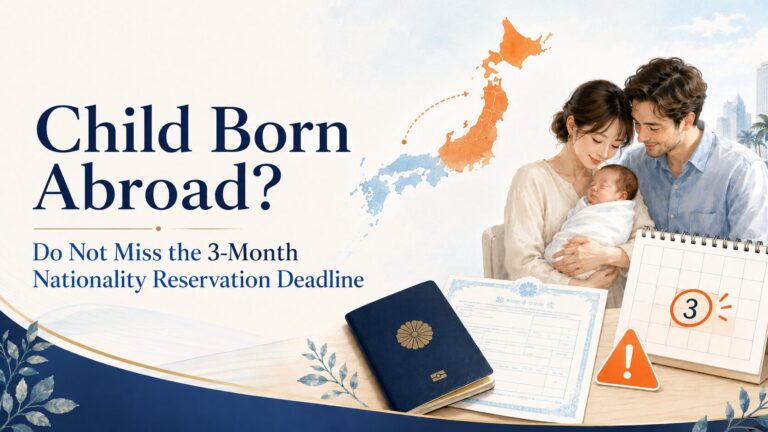
Child Born Abroad to a Japanese Parent? Do Not Miss the 3-Month Nationality Reservation Deadline
When a child is born outside Japan, completing the local birth registration does not automatically complete the procedures required in Japan.
This is particularly important when a child is born abroad and acquires both Japanese nationality and a foreign nationality at birth. In such a case, the parents generally need to submit a Japanese birth notification and clearly state that they wish to reserve the child’s Japanese nationality within three months of the child’s birth.
If the required nationality reservation is not made within the legal deadline, the child may lose Japanese nationality retroactively from the time of birth.
This can affect the child’s entry in a Japanese family register, eligibility for a Japanese passport, and future procedures involving Japan.
Important: This rule does not apply to every child born outside Japan
The nationality reservation requirement generally becomes relevant when a child is born outside Japan and also acquires a foreign nationality automatically at birth.
Whether a child acquires a foreign nationality at birth depends on the nationality laws of the country of birth and the country or countries of the parents. Each case must therefore be checked individually.
This article is for you if:
- You are Japanese and live outside Japan
- You are in an international marriage or partnership
- You are planning to give birth outside Japan
- Your child has already been born abroad, but you have not reported the birth to Japan
- You are unsure whether your child has Japanese nationality
- You want to apply for a Japanese passport for your child
- You are unfamiliar with Japan’s family register and nationality procedures
目次
- 1 What is Japanese nationality reservation?
- 2 Why is the three-month deadline so important?
- 3 Which children may be affected?
- 4 Birth notification and nationality reservation are not the same thing
- 5 Where can the birth be reported?
- 6 General filing process
- 7 What documents are generally required?
- 8 What if more than three months have already passed?
- 9 How can this affect a Japanese passport?
- 10 Common misunderstandings
- 11 Checklist for Japanese parents living abroad
- 12 Conclusion
- 13 Unsure how to report your child’s birth to Japan?
What is Japanese nationality reservation?
Under Japan’s Nationality Act, a child generally acquires Japanese nationality at birth if the child’s father or mother is a Japanese national at the time of birth.
However, the existence of a Japanese biological parent does not always settle the matter by itself. A legally recognized parent-child relationship must exist under the applicable law.
For example, where the mother is foreign and the Japanese father is not married to her at the time of the child’s birth, the timing and legal effect of acknowledgment by the father may affect whether the child acquired Japanese nationality at birth.
A separate rule applies when a child:
- is born outside Japan; and
- also acquires a foreign nationality automatically through the birth.
In this situation, the person submitting the Japanese birth notification must state that the child will retain, or “reserve,” Japanese nationality.
Key point
Nationality reservation is the formal declaration that a child born abroad who also acquired a foreign nationality will retain Japanese nationality.
Why is the three-month deadline so important?
A birth outside Japan must generally be reported to the Japanese authorities within three months, counting from and including the date of birth.
For example, if a child is born on October 23, the deadline is January 22 of the following year.
For a child who acquired a foreign nationality at birth, the Japanese birth notification must be submitted within that period together with the declaration reserving Japanese nationality.
If the required nationality reservation is not made within the deadline, Article 12 of Japan’s Nationality Act provides that the child loses Japanese nationality retroactively from the time of birth.
This is not merely a late-filing penalty. It may legally affect whether the child is regarded as having retained Japanese nationality from birth.
Do not calculate the deadline casually
The official guidance states that the period is calculated from and includes the date of birth. Contact the relevant Japanese embassy or consulate as soon as possible after the birth rather than waiting until the end of the three-month period.
Which children may be affected?
The rule is not based only on the place of birth.
The nationality reservation issue generally arises when all of the following factors are present:
- The child was born outside Japan
- The child acquired Japanese nationality at birth through a Japanese parent
- The child also acquired another nationality automatically at birth
A child may acquire a foreign nationality because the country of birth grants nationality to children born in its territory. This is often described as nationality based on place of birth.
A child may also acquire a foreign nationality through a foreign parent. This is often described as nationality based on descent.
However, nationality laws differ significantly between countries. Some countries automatically grant nationality through a parent, while others impose additional conditions. Some countries grant nationality based on the place of birth, while others generally do not.
For that reason, it is necessary to confirm both Japanese law and the nationality law of the relevant foreign country.
Birth notification and nationality reservation are not the same thing
A Japanese birth notification reports the child’s birth to the Japanese authorities so that the birth can be processed under Japan’s family registration system.
Nationality reservation is the declaration that the child will retain Japanese nationality when the child was born abroad and also acquired a foreign nationality at birth.
In practice, nationality reservation is normally made as part of the Japanese birth notification. The appropriate person must sign the section stating that Japanese nationality is reserved.
Therefore, nationality reservation does not necessarily require a completely separate form. Nevertheless, it is legally distinct from merely reporting the birth.
Submitting a birth notification without properly completing the nationality reservation declaration may not be sufficient in a case where nationality reservation is required.
| Procedure | Main purpose |
|---|---|
| Japanese birth notification | Reports the child’s birth and provides the information required for processing under Japan’s family registration system. |
| Nationality reservation declaration | Expresses the intention to retain Japanese nationality when a child born outside Japan also acquired a foreign nationality at birth. |
| Local birth registration | Registers the birth under the law of the country or region where the child was born. It does not automatically replace the Japanese procedure. |
Where can the birth be reported?
According to the Ministry of Foreign Affairs of Japan, the birth notification can generally be submitted through one of the following routes:
- In person at the Japanese embassy or consulate-general with jurisdiction over the place of residence
- By post to the relevant Japanese embassy or consulate-general, where postal filing is accepted
- By post or submission to the appropriate municipal office in Japan
The practical method, required number of copies, acceptable certificates, and mailing rules should be confirmed with the relevant embassy, consulate-general, or municipal office before submission.
General filing process
The following is a general outline. It is not a complete list for every country.
| Stage | What to do |
|---|---|
| 1. Confirm the child’s nationalities | Check whether the child acquired Japanese nationality and whether the child automatically acquired a foreign nationality at birth. |
| 2. Contact the Japanese mission | Ask the Japanese embassy or consulate-general with jurisdiction for the latest forms, required documents, number of copies, and filing method. |
| 3. Obtain the local birth certificate | Obtain the birth registration certificate or other official birth document issued by the relevant foreign authority, hospital, doctor, or other authorized body. |
| 4. Prepare a Japanese translation | Prepare the Japanese translation required for the foreign-language birth document. Confirm whether the translator’s name and other information must be stated. |
| 5. Complete the Japanese birth notification | Complete the form carefully, including the nationality reservation section when it applies. |
| 6. Submit within three months | Submit the documents without waiting until the final days of the legal period. |
| 7. Confirm family-register processing | After filing, confirm when the child’s information is expected to appear in the relevant Japanese family register. |
What documents are generally required?
The Ministry of Foreign Affairs generally lists documents such as:
- A completed Japanese birth notification form
- An original birth registration certificate issued by a foreign authority, or a birth certificate prepared by a doctor or other authorized person
- A Japanese translation of the foreign-language certificate
Additional documents or information may be required depending on:
- The country or region of birth
- The nationality of each parent
- The parents’ marital status
- Whether acknowledgment of parentage is involved
- The format of the local birth certificate
- The filing method
- The requirements of the particular Japanese embassy or consulate-general
Do not rely only on a general online checklist. Always confirm the current requirements with the Japanese embassy or consulate-general that has jurisdiction over your area.
Prepare before the child is born
If you are planning to give birth abroad, check the required forms, birth-certificate procedure, translation requirements, and submission method before delivery. The three-month period can pass quickly while caring for a newborn.
What if more than three months have already passed?
Do not assume either that the child has definitely retained Japanese nationality or that nothing can be done.
If the child was born outside Japan, acquired a foreign nationality at birth, and the required nationality reservation was not made within three months, Japanese law may treat the child as having lost Japanese nationality retroactively from birth.
However, the correct handling of a particular case depends on the actual facts, including:
- The exact date and place of birth
- The nationality of each parent at the time of birth
- Whether a legal parent-child relationship existed at birth
- Whether the child actually acquired a foreign nationality automatically
- Whether any Japanese birth notification was submitted
- What was written in the submitted notification
- Whether there were circumstances beyond the filer’s control
You should promptly contact the Japanese embassy or consulate-general, the appropriate municipal office in Japan, or a Legal Affairs Bureau that handles nationality matters.
In certain cases, a person who lost Japanese nationality because nationality was not reserved may be able to reacquire Japanese nationality by notification under Article 17, paragraph 1 of the Nationality Act.
The official Ministry of Justice procedure applies to a person who:
- lost Japanese nationality under Article 12 because nationality was not reserved;
- is under 18 years of age; and
- has a domicile in Japan.
These conditions should not be interpreted without examining the individual case. In particular, temporarily staying in Japan does not necessarily mean that the person has a legal domicile in Japan for this purpose.
Do not submit a late notification based only on your own interpretation
Nationality is a legal status with serious consequences. When the three-month deadline has passed, first obtain instructions from the Japanese embassy, consulate-general, municipal office, or Legal Affairs Bureau responsible for the case.
How can this affect a Japanese passport?
A Japanese passport is issued to a Japanese national.
For a child born abroad, the Japanese birth notification normally needs to be processed and the child’s information reflected in the relevant Japanese family register before a standard passport application can proceed.
If there is uncertainty about whether the child retained Japanese nationality, the passport authority may require the nationality issue to be clarified before issuing a passport.
Therefore, the fact that one parent holds a Japanese passport does not by itself guarantee that a passport can immediately be issued to the child.
Common misunderstandings
Misunderstanding 1: Every child born abroad must reserve Japanese nationality within three months.
That is not accurate. Nationality reservation generally becomes an issue when a child born outside Japan also acquires a foreign nationality at birth.
Misunderstanding 2: The local birth registration automatically registers the child in Japan.
It does not. Registration under the law of the country of birth and notification under Japan’s family registration system are separate procedures.
Misunderstanding 3: Submitting a Japanese birth notification automatically completes nationality reservation.
Not necessarily. Where nationality reservation is required, the intention to reserve Japanese nationality must be properly stated in the notification.
Misunderstanding 4: The three-month period begins when the birth certificate is issued.
It generally begins from the date of birth, not from the date on which the local authority issues the birth certificate.
Misunderstanding 5: A child of a Japanese parent can always receive a Japanese passport.
A passport application depends on the child having Japanese nationality and satisfying the applicable passport-document requirements.
Misunderstanding 6: An administrative scrivener can make the final decision about nationality.
An administrative scrivener can help organize facts, explain general procedures, and assist with document preparation where legally permitted. However, the final administrative determination concerning nationality is made by the competent Japanese authorities, such as a Legal Affairs Bureau, embassy, consulate-general, municipal office, or passport authority.
Checklist for Japanese parents living abroad
- Was either parent a Japanese national when the child was born?
- Did a legal parent-child relationship exist at the time of birth?
- Was the child born outside Japan?
- Did the child automatically acquire a foreign nationality at birth?
- What is the child’s exact three-month filing deadline?
- Which Japanese embassy or consulate-general has jurisdiction?
- Which local birth certificate must be obtained?
- Is a Japanese translation required?
- Has the nationality reservation section been completed and signed?
- How many copies must be submitted?
- Will the filing be made in person or by post?
- When will the child be entered in the Japanese family register?
- What documents will later be required for the child’s passport?
Conclusion
A child born abroad may acquire Japanese nationality at birth when the father or mother is Japanese. However, when the child also acquires a foreign nationality automatically at birth, a nationality reservation declaration may be required.
The Japanese birth notification and nationality reservation must generally be completed within three months, counting from the date of birth.
Missing the deadline may result in the child losing Japanese nationality retroactively from birth. This may affect the child’s Japanese family-register entry, passport application, and other procedures involving Japan.
At the same time, the three-month nationality reservation rule does not apply to every child born outside Japan. The answer depends on whether the child acquired a foreign nationality at birth and on the individual family and legal circumstances.
Parents who are expecting a child abroad should check the procedure before the birth. Parents whose child has already been born should contact the relevant Japanese authority without delay.
ONLINE CONSULTATION
Unsure how to report your child’s birth to Japan?
Trust Administrative Scrivener Office provides online consultations for Japanese nationals and international families who need help understanding Japanese birth notifications, family-register documents, translations, and related procedures.
During the consultation, we can review the facts you provide, help you identify the relevant authorities, and explain the documents and procedures that may need to be confirmed.
Please note that our office cannot make the final legal determination as to whether a child currently holds Japanese nationality. That determination must be confirmed by the competent Japanese embassy, consulate-general, Legal Affairs Bureau, municipal office, or other relevant authority.
We do not provide individual nationality assessments through free email, LINE, or contact-form messages. If you would like us to review your specific circumstances, please book a paid online consultation.
Trust Administrative Scrivener Office
Based in Kitakyushu, Fukuoka, Japan, we support Japanese nationals, international families, and foreign residents with official procedures, document preparation, translations, and immigration-related matters.
Important legal notice
This article is provided for general informational purposes only and does not determine whether any particular person holds Japanese nationality. The applicable treatment may differ depending on the place of birth, the parents’ nationalities, marital status, legal parent-child relationship, filing history, and the nationality law of the relevant foreign country. For advice concerning a specific procedure, contact the Japanese embassy or consulate-general with jurisdiction, a Legal Affairs Bureau, the relevant municipal office, or another competent government authority.
Official sources
- e-Gov Law Search: Nationality Act
— Articles 2, 12 and 17 - e-Gov Law Search: Family Register Act
— Articles 49 and 104 - Ministry of Foreign Affairs of Japan: Family Register and Nationality Notifications
— Birth-notification deadline, filing methods and general documents - Ministry of Justice: Nationality Q&A
— Acquisition and loss of Japanese nationality and nationality procedures - Ministry of Justice: Notification for Reacquisition of Japanese Nationality
— Procedure under Article 17, paragraph 1 of the Nationality Act - Ministry of Foreign Affairs of Japan: Official Birth Notification Form and Instructions
— Nationality reservation signature and filing instructions
This article is based on official information confirmed on July 19, 2026. Laws, official interpretations, forms, required documents, and embassy procedures may change. Always check the latest instructions issued by the Japanese embassy, consulate-general, Legal Affairs Bureau, or municipal office responsible for your case.