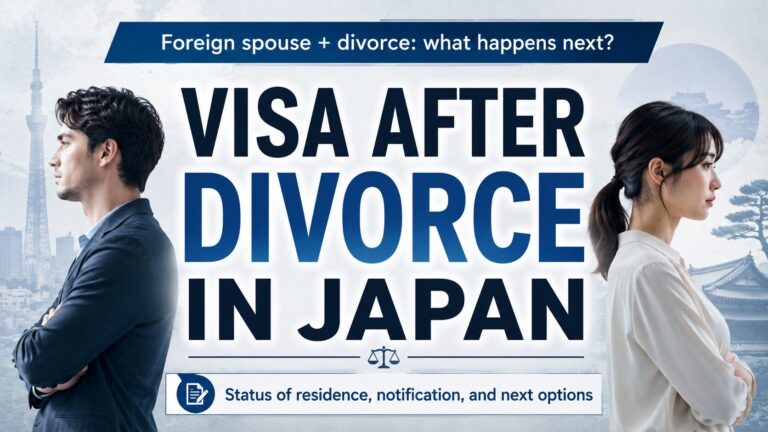
If you divorce your Japanese spouse in Japan, your visa situation may change.
Many foreign nationals living in Japan hold the status of residence called “Spouse or Child of Japanese National” because they are married to a Japanese citizen.
However, if the marriage ends by divorce, the basis of that status of residence may no longer exist.
Divorce does not mean that your residence card immediately becomes invalid. However, you must take the correct immigration steps as soon as possible.
This article explains what happens to your visa after divorce from a Japanese spouse, what notification is required, and what options may be available if you want to continue living in Japan.
This article is for you if:
- You are a foreign national married to a Japanese citizen
- You are considering divorce in Japan
- You have already divorced your Japanese spouse
- You want to know whether you can stay in Japan after divorce
- You have a Japanese child and want to continue living in Japan
- You are worried about changing your status of residence after divorce
Important: You must notify Immigration within 14 days after divorce
If you are a mid- to long-term resident in Japan with the status of residence of “Spouse or Child of Japanese National,” “Spouse or Child of Permanent Resident,” or certain cases of “Dependent,” and you divorce or your spouse passes away, you must submit a Notification of Relationship with Spouse to the Immigration Services Agency of Japan within 14 days.
Submitting a divorce notification to your city hall or ward office is not enough. The notification to Immigration is a separate procedure.
- 1 Does divorce automatically cancel your spouse visa?
- 2 Step 1: Submit the Notification of Relationship with Spouse
- 3 Can you keep living in Japan on a spouse visa after divorce?
- 4 What status of residence can you change to after divorce?
- 5 Option 1: Changing to Long-Term Resident after divorce
- 6 Option 2: If you have a Japanese child
- 7 Option 3: Changing to a work-related status of residence
- 8 Option 4: Remarriage
- 9 Option 5: Starting a business in Japan
- 10 What documents may be important after divorce?
- 11 Common mistakes after divorce
- 12 What should you do first after divorce?
- 13 Summary
- 14 Need help after divorce in Japan?
Does divorce automatically cancel your spouse visa?
No. Your status of residence does not automatically disappear on the day you divorce.
If you currently hold the status of residence of “Spouse or Child of Japanese National” or “Spouse or Child of Permanent Resident,” your residence card remains valid until the expiration date printed on the card.
However, this does not mean you can simply continue living in Japan without taking any action.
The reason is simple: once you divorce, you are no longer engaging in the activity or holding the personal status that formed the basis of your spouse status.
Therefore, if you want to continue living in Japan after divorce, you should consider changing your status of residence to another status that matches your actual situation.
Key point
Divorce does not immediately invalidate your residence card. However, if you do not take proper action after divorce, your status of residence may become a serious problem, especially at the time of renewal or change of status.
Step 1: Submit the Notification of Relationship with Spouse
After divorce, the first immigration procedure is the Notification of Relationship with Spouse.
This notification is required when a foreign national who resides in Japan as a spouse divorces or is bereaved of the spouse.
| Item | Explanation |
|---|---|
| Who must notify? | Foreign nationals staying in Japan as a spouse under certain residence statuses, such as Spouse or Child of Japanese National, Spouse or Child of Permanent Resident, or Dependent in spouse-related cases. |
| When? | Within 14 days from the date of divorce or the death of the spouse. |
| Where? | To the Immigration Services Agency of Japan. |
| How? | Online, at the immigration counter, or by mail. |
How to submit the notification
You can submit the notification in one of the following ways.
1. Online
You can use the Immigration Services Agency’s electronic notification system. This is often the most convenient method.
2. At the counter
You can submit the notification at a regional immigration services bureau by presenting your residence card.
3. By mail
You can mail the notification form together with a copy of your residence card. It is safer to use a trackable mailing method.
Important warning
If you fail to notify Immigration of your divorce from a Japanese spouse, you may be subject to a fine of up to 200,000 yen under the Immigration Control Act.
Even if you were not intentionally hiding the divorce, failure to notify may negatively affect future immigration procedures.
Can you keep living in Japan on a spouse visa after divorce?
In principle, you should not remain on a spouse-based status for a long period after divorce without taking action.
The status of residence of “Spouse or Child of Japanese National” is based on your personal status as the spouse of a Japanese national.
After divorce, that relationship no longer exists.
Under Japan’s immigration system, if a foreign national does not continue the activities corresponding to their status of residence for a certain period without a valid reason, the status may become subject to revocation.
In official cancellation case examples published by the Immigration Services Agency, there are cases where a person with “Spouse or Child of Japanese National” or “Spouse or Child of Permanent Resident” continued staying in Japan for more than six months after divorce, and this was treated as a case related to revocation of status.
Practical advice
If you want to stay in Japan after divorce, do not wait until your residence card is about to expire. You should review your next status of residence as early as possible.
What status of residence can you change to after divorce?
The best option depends on your individual circumstances.
Typical possibilities include:
- Long-Term Resident
- Work-related status, such as Engineer / Specialist in Humanities / International Services
- Spouse or Child of Japanese National, if you have a Japanese child
- Spouse or Child of Permanent Resident, if you remarry a permanent resident
- Business Manager, if you can meet the current requirements
- Other status depending on your family situation, work, education, or humanitarian circumstances
However, you cannot choose a status simply because you want it. You must meet the requirements for that status.
Option 1: Changing to Long-Term Resident after divorce
One common option after divorce is to apply for a change of status to Long-Term Resident.
This may be considered when a foreign national has built a stable life in Japan and there are special circumstances that justify continued residence.
In divorce cases, Immigration may examine factors such as:
- The length of the actual married life in Japan
- Whether the marriage was genuine
- Whether the couple lived together
- The reason for divorce
- The foreign national’s income and ability to live independently
- Tax and social insurance payment history
- Conduct and compliance with Japanese law
- Whether there are Japanese children
- The degree of settlement in Japan
There is often discussion that an actual marital relationship of around three years may be important. However, this should not be understood as an automatic rule.
Even if the marriage lasted more than three years, approval is not guaranteed. On the other hand, even if the period is shorter, there may be other important circumstances, such as raising a Japanese child or being a victim of domestic violence.
Important point about “genuine married life”
If you were legally married but lived separately for a long time, spent much of the marriage outside Japan, or had little actual family life together, Immigration may question whether there was a genuine marital relationship.
Option 2: If you have a Japanese child
If you have a child with Japanese nationality, your situation may be different.
If you are actually raising and caring for your minor Japanese child in Japan, this may become an important reason for continued residence.
Immigration may consider factors such as:
- Whether the child has Japanese nationality
- Whether the child is a minor
- Whether you have parental authority or actual custody
- Whether you are actually caring for and raising the child
- The child’s school, living environment, and welfare
- Your income and ability to support the child
- Your conduct and compliance with Japanese law
The most important point is not simply whether you have a Japanese child on paper.
Immigration will look at whether you are actually taking care of the child and whether your continued stay in Japan is necessary for the child’s welfare.
Be careful
If the child is living abroad with grandparents, or if you are not actually involved in the child’s daily care, it may be difficult to rely on the child as the main reason for continued residence in Japan.
Option 3: Changing to a work-related status of residence
If you have a stable job in Japan, you may be able to change to a work-related status of residence.
For example, some people may consider Engineer / Specialist in Humanities / International Services.
However, this status is not available for all jobs.
Immigration will examine whether your job duties match the status of residence, and whether your educational background or professional experience supports that work.
Typical points include:
- Your academic background
- Your work experience
- Your job description
- Your employment contract
- Your salary level
- The stability of the employer
- Whether the job requires specialized knowledge
For example, general restaurant work, simple factory work, cleaning, or other simple labor usually does not fit this status.
If you want to change to a work-related status, it is important to confirm whether your actual job duties match the legal requirements.
Option 4: Remarriage
If you remarry a Japanese national or a permanent resident, you may be able to apply for a spouse-based status again.
However, Immigration will carefully examine whether the new marriage is genuine.
The following points may be reviewed:
- How and when you met your new spouse
- The timeline from divorce to remarriage
- Whether you live together
- Your communication history and relationship history
- The financial and living situation of the couple
- Whether there is any suspicion of a marriage of convenience
If the remarriage happens very soon after divorce, or if the circumstances are unclear, the examination may become more careful.
It is important to prepare documents that show the reality of the relationship.
Option 5: Starting a business in Japan
Some people consider starting a business after divorce and changing to Business Manager.
However, this option has become much more difficult than before.
As of the revised rules effective October 16, 2025, the Immigration Services Agency explains that the Business Manager status generally requires, among other things, a business scale involving 30 million yen or more in capital or business assets, and a certain level of Japanese language ability by the applicant or a full-time employee.
Therefore, the old idea that “5 million yen is enough to obtain a Business Manager visa” is no longer accurate under the current rules.
Business Manager may be possible in some cases, but it should not be treated as an easy backup option after divorce.
Important update
If you are considering changing to Business Manager after divorce, you should check the current requirements carefully. The standards changed significantly in 2025, and the required business scale is now much higher than before.
What documents may be important after divorce?
The required documents depend on the status you apply for and your personal situation.
However, in many divorce-related cases, the following materials may become important:
- Divorce certificate or family register documents showing the divorce
- Residence card and passport
- Documents showing your residence history in Japan
- Documents showing the actual married life
- Documents explaining the reason for divorce
- Income documents, such as tax certificates and withholding tax slips
- Employment contract or certificate of employment
- Documents showing tax and social insurance payment status
- Documents related to a Japanese child, if applicable
- School or childcare documents for the child
- Documents showing custody or actual care of the child
- Explanation letter or statement of reasons
In difficult cases, a well-prepared statement of reasons can be very important.
It should explain your life in Japan, the reason for divorce, your current situation, your income, your family responsibilities, and why continued residence in Japan is necessary.
Common mistakes after divorce
After divorce, many people make mistakes because they do not know the immigration rules.
Please be especially careful about the following:
Mistake 1
Thinking that divorce does not matter until the residence card expires.
Mistake 2
Submitting a divorce notification only to the city office and forgetting the immigration notification.
Mistake 3
Waiting for six months or longer before thinking about changing status.
Mistake 4
Assuming that Long-Term Resident will always be approved after divorce.
Mistake 5
Changing to an unsuitable status without checking the requirements.
Mistake 6
Preparing documents only at the last minute before the period of stay expires.
What should you do first after divorce?
If you have divorced your Japanese spouse, the first steps are:
- Confirm the date of divorce
This date is important for the 14-day immigration notification period. - Submit the Notification of Relationship with Spouse
This should be done within 14 days. - Check your residence card expiration date
Do not wait until just before expiration. - Review your possible next status of residence
Long-Term Resident, work status, child-related status, remarriage-based status, or other options may be considered depending on your situation. - Prepare evidence
Documents showing your life in Japan, income, child custody, tax payments, and reason for continued residence may be important. - Consult a specialist if your case is complex
Divorce-related immigration cases can be highly fact-specific.
Summary
If you divorce your Japanese spouse, your spouse-based status of residence does not immediately become invalid.
However, you must notify the Immigration Services Agency within 14 days, and you should consider changing your status of residence if you want to continue living in Japan.
The best option depends on your circumstances.
If you had a genuine married life in Japan for a significant period, Long-Term Resident may be considered. If you are raising a Japanese child, the child’s welfare may become an important factor. If you have stable employment, a work-related status may be possible. If you remarry, a spouse-based status may be considered again. If you want to start a business, Business Manager may be an option, but the current requirements are much stricter than before.
Divorce is already a difficult life event. Immigration procedures can make the situation even more stressful.
For that reason, it is important to act early, understand the rules correctly, and prepare documents carefully.
IMMIGRATION SUPPORT IN JAPAN
Need help after divorce in Japan?
Trust Administrative Scrivener Office supports foreign nationals in Japan with residence status change applications, spouse-related immigration matters, and document preparation.
We do not provide individual case judgments by free email, LINE, or contact form messages.
If you need advice for your specific situation, please book a paid consultation.
Trust Administrative Scrivener Office
Based in Kitakyushu, Fukuoka, we support foreign nationals with visa, residence status, naturalization, and official document procedures in Japan.