PERMANENT RESIDENCY IN JAPAN
Permanent Residency in Japan: Requirements, Special Exceptions, and Important Updates
Permanent Residency is one of the most important residence statuses for foreign nationals who wish to live in Japan long-term. However, Japan’s Permanent Residency requirements and related procedures have been updated, and applicants now need to pay closer attention to tax, pension, health insurance, residence period, and official self-check requirements.
This article is recommended for:
- Foreign nationals considering Permanent Residency in Japan
- People who want to understand the latest official requirements
- Spouses of Japanese nationals, Long-Term Residents, workers, and Highly Skilled Professionals
- People who want to check whether now is the right timing to apply
- 1 What Is Permanent Residency in Japan?
- 2 Recent Important Updates
- 3 Main Legal Requirements for Permanent Residency
- 4 General 10-Year Residence Requirement
- 5 Special Exceptions to the 10-Year Rule
- 6 Special Rule for Spouses and Children
- 7 Current Residence Period: 3 Years or 5 Years?
- 8 Official Self-Check Sheet Before Applying
- 9 Required Documents
- 10 Application Process
- 11 Application Fee and Processing Time
- 12 Guarantor for Permanent Residency
- 13 Permanent Residency Can Still Be Affected After Approval
- 14 Practical Checklist Before Applying
- 15 Conclusion
- 16 Need professional advice?
- 17 Official References
What Is Permanent Residency in Japan?
Permanent Residency is a residence status granted by the Minister of Justice to foreign nationals who are allowed to live in Japan permanently.
Once granted, a Permanent Resident is not restricted by a specific period of stay or work activity restrictions. This means that a Permanent Resident can work in any lawful occupation and continue living in Japan with greater stability.
Important: Permanent Residency does not mean Japanese nationality. A Permanent Resident remains a foreign national and must still comply with residence card rules, address notification rules, re-entry procedures, tax obligations, and social insurance obligations.
Recent Important Updates
Applicants should be aware of the following recent updates and policy direction:
| Item | Updated Point |
|---|---|
| Guidelines | The Permanent Residency Guidelines were revised on February 24, 2026. |
| Application fee | For approvals from April 1, 2025 onward, the fee is 10,000 yen. |
| Self-check sheet | Applicants should check the official Permanent Residency Self-Check Sheet before applying. |
| 3-year residence period | Until March 31, 2027, a 3-year period of stay may be treated as the longest period of stay under the transitional measure. |
| After approval | Permanent Residents are still expected to properly pay taxes and social insurance and comply with immigration obligations. |
Main Legal Requirements for Permanent Residency
The basic requirements for Permanent Residency are generally divided into the following three categories.
1. Good Conduct
The applicant must comply with Japanese laws and live in a way that is not socially criticized. Criminal penalties, repeated traffic violations, and serious legal violations may negatively affect the application.
2. Independent Livelihood
The applicant must be able to maintain a stable life in Japan without becoming a public burden. Income, assets, employment stability, family size, and household circumstances are reviewed.
3. Benefit to Japan
The applicant’s permanent residence must be recognized as being in the interests of Japan. This includes residence history, public obligation compliance, current residence period, and overall stability.
Important practical point: Even if taxes, pension, or health insurance have already been paid by the time of application, late payment may still be evaluated negatively if they were not paid within the original deadline.
General 10-Year Residence Requirement
As a general rule, an applicant must have continuously lived in Japan for at least 10 years. Within this 10-year period, the applicant must generally have stayed in Japan for at least 5 years with a work-related status or residence-based status.
However, there are several important exceptions where the required period may be shortened.
Special Exceptions to the 10-Year Rule
| Category | Required Residence Period |
|---|---|
| Spouse of Japanese national, Permanent Resident, or Special Permanent Resident | A genuine marriage for at least 3 years and continuous residence in Japan for at least 1 year. |
| Child of Japanese national, Permanent Resident, or Special Permanent Resident | Continuous residence in Japan for at least 1 year. |
| Long-Term Resident | Continuous residence in Japan for at least 5 years as a Long-Term Resident. |
| Recognized refugee or person recognized as eligible for complementary protection | Continuous residence in Japan for at least 5 years after recognition. |
| Highly Skilled Professional with 70 points or more | Generally 3 years if the points requirement has been continuously met. |
| Highly Skilled Professional with 80 points or more | Generally 1 year if the points requirement has been continuously met. |
| Special Highly Skilled Professional | Generally 1 year if the applicable criteria are met. |
Special Rule for Spouses and Children
For spouses and children of Japanese nationals, Permanent Residents, or Special Permanent Residents, the requirements for “good conduct” and “independent livelihood” are legally relaxed.
However: This does not mean that tax, pension, health insurance, income, and household stability are ignored. In practice, Immigration still reviews whether the household is stable and whether public obligations have been properly fulfilled.
Current Residence Period: 3 Years or 5 Years?
The latest guideline requires the applicant to hold the longest period of stay available for their current residence status.
However, there is a transitional measure. Until March 31, 2027, a person holding a 3-year period of stay may be treated as holding the longest period of stay for Permanent Residency purposes.
Practical advice: If you currently have a 3-year residence period and are considering Permanent Residency, it is important to confirm whether your application timing falls within the transitional measure and whether your overall situation is strong enough.
Official Self-Check Sheet Before Applying
The Immigration Services Agency provides official Permanent Residency Self-Check Sheets. Applicants should review the relevant sheet before applying.
Important points from the official guidance:
- If even one answer is “No,” the application may have a high risk of refusal.
- Even if all answers are “Yes,” approval is not guaranteed.
- The correct sheet depends on your residence status, such as spouse, Long-Term Resident, work-related status, Highly Skilled Professional, or Special Highly Skilled Professional.
Required Documents
The required documents depend on the applicant’s residence status and family situation. In general, Permanent Residency applications require documents related to identity, residence history, income, tax payment, pension, health insurance, and guarantor information.
| Category | Examples |
|---|---|
| Basic application documents | Application form, photo, Statement of Reasons |
| Identity documents | Passport, residence card, residence certificate |
| Family documents | Family register, marriage documents, family relationship documents, depending on status |
| Income and tax documents | Tax certificates, income certificates, tax payment certificates |
| Pension and health insurance | Pension records, health insurance payment records, social insurance documents |
| Guarantor documents | Letter of guarantee and identity document of the guarantor |
| Letter of Understanding | Required for Permanent Residency applications since October 1, 2021. |
Documents issued in Japan generally need to be issued within 3 months. If a document is written in a foreign language, a Japanese translation should be attached.
Application Process
Step 1: Check Eligibility
Confirm your residence history, current residence period, tax, pension, health insurance, income, family situation, and any possible negative factors.
Step 2: Prepare Documents
Collect certificates and prepare supporting documents. If there are concerns, prepare explanations and evidence in advance.
Step 3: Submit the Application
Submit the application to the regional Immigration office with jurisdiction over your residence. An authorized professional may submit the application on your behalf.
Step 4: Respond to Additional Requests
Immigration may request additional documents or explanations. Responding accurately and within the deadline is important.
Step 5: Receive the Result
If approved, you will pay the official fee and receive your Permanent Resident residence card.
Application Fee and Processing Time
| Item | Current Information |
|---|---|
| Official fee | 10,000 yen, paid by revenue stamp when permission is granted. |
| Standard processing period | 4 to 6 months. |
| Appeal system | There is no administrative appeal procedure for a refusal of Permanent Residency. |
Guarantor for Permanent Residency
A guarantor is generally required for a Permanent Residency application. The guarantor is usually a person living in Japan, such as a Japanese national, Permanent Resident, or Special Permanent Resident.
The guarantor for immigration purposes is different from a civil-law joint guarantor. However, the applicant should explain the role clearly and choose someone who understands the documents they are signing.
Permanent Residency Can Still Be Affected After Approval
Permanent Residency provides strong stability, but it is not completely risk-free. Permanent Residents must continue to comply with Japanese law and immigration obligations.
Important:
- Failure to comply with immigration obligations may become a problem.
- Intentional non-payment of taxes or social insurance may become a serious issue.
- Serious criminal conduct may affect the status.
- In some cases, the status may be changed to another residence status instead of immediate removal.
The official Q&A explains that the system is aimed at cases where the residence situation is not considered good, and not at the majority of Permanent Residents who properly comply with their obligations.
Practical Checklist Before Applying
- Have you lived in Japan for the required number of years?
- Do you qualify for any special exception to the 10-year rule?
- Do you currently hold an appropriate residence period?
- Have taxes been paid properly and on time?
- Have pension and health insurance premiums been paid properly?
- Is your income and household situation stable?
- Are there any criminal records, traffic violations, or immigration notification problems?
- Can you explain your life in Japan clearly in a Statement of Reasons?
- Have you checked the official Self-Check Sheet?
Conclusion
Permanent Residency in Japan offers major benefits, including no work restrictions and no residence period renewal. However, the application is carefully reviewed, and recent updates show that Immigration places strong emphasis on tax, pension, health insurance, current residence period, and overall compliance.
The best timing to apply depends on the applicant’s individual situation. If there are late payments, unstable income, insufficient documents, or unclear residence history, it may be better to prepare carefully before applying.
Permanent Residency is not simply about the number of years you have lived in Japan. It is about proving that your life in Japan is stable, lawful, and appropriate for long-term residence.
PROFESSIONAL SUPPORT
Need professional advice?
If you need individual advice regarding Permanent Residency, residence status, visa procedures, or official documents in Japan, please book a paid consultation.
We do not provide individual case assessments through free blog comments, general contact forms, or social media messages.
All consultations require advance booking and advance payment.
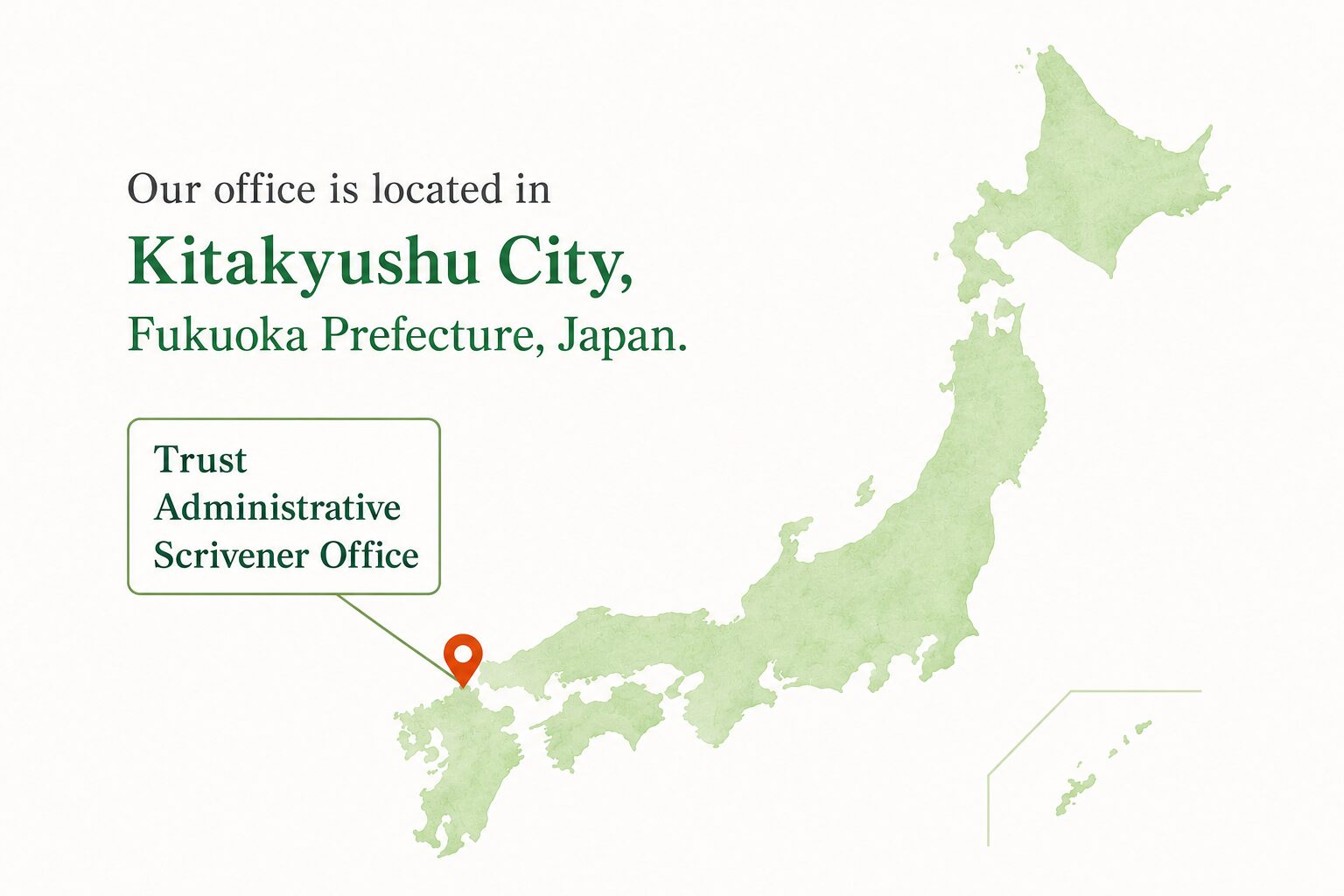
Trust Administrative Scrivener Office
Based in Kitakyushu, Fukuoka, Japan | Online consultations available
Official References
- Immigration Services Agency: Guidelines for Permanent Residency Permission
- Immigration Services Agency: Permanent Residency Application
- Immigration Services Agency: Permanent Residency Application for Spouses and Children
- Immigration Services Agency: Q&A on Appropriate Management of the Permanent Residency System