PERMANENT RESIDENCY IN JAPAN
Permanent Residency for Spouses of Japanese Nationals in Japan
For foreign nationals living in Japan as the spouse of a Japanese citizen, applying for Permanent Residency is an important step toward long-term stability. However, Japan’s permanent residency system has been updated in recent years, and applicants now need to pay closer attention to tax, pension, health insurance, residence period, and official self-check requirements.
This article explains the key points for Permanent Residency applications by spouses of Japanese nationals, based on the latest official information published by the Immigration Services Agency of Japan.

- 1 What Has Changed Recently?
- 2 Basic Requirements for Spouses of Japanese Nationals
- 3 Current Residence Period: 3 Years or 5 Years?
- 4 Official Self-Check Sheet Before Applying
- 5 Taxes, Pension, and Health Insurance Are Critical
- 6 Japanese Spouse’s Compliance Also Matters
- 7 Statement of Reasons: Why It Still Matters
- 8 Required Documents: Main Categories
- 9 Application Fee and Processing Time
- 10 Permanent Residency After Approval: Not Completely “Risk-Free”
- 11 Frequently Asked Questions
- 12 Administrative Scrivener’s Practical Advice
- 13 Conclusion
- 14 Need Support for Permanent Residency in Japan?
What Has Changed Recently?
Key updates applicants should know:
- The Permanent Residency Guidelines were revised on February 24, 2026.
- The official application fee increased to 10,000 yen for approvals from April 1, 2025.
- Applicants are strongly encouraged to use the official Permanent Residency Self-Check Sheet before applying.
- If even one answer on the self-check sheet is “No,” the application may have a high risk of refusal.
- Even after obtaining Permanent Residency, failure to pay taxes or social insurance may become a serious issue under the revised system.
Permanent Residency is not simply a matter of living in Japan for a certain number of years. Immigration now places strong emphasis on whether the applicant has continuously fulfilled public obligations, especially taxes, pension, and health insurance.
Basic Requirements for Spouses of Japanese Nationals
For spouses of Japanese nationals, there is a special exception to the general 10-year residence requirement.
| Requirement | Details |
|---|---|
| Marriage period | The marriage must have continued for at least 3 years with a genuine marital relationship. |
| Residence in Japan | The applicant must have continuously lived in Japan for at least 1 year. |
| Current residence period | The applicant must generally hold the longest residence period available for the current status. |
| Public obligations | Taxes, pension, health insurance, and Immigration Act notification duties must be properly fulfilled. |
| Public health | The applicant must not be harmful from a public health perspective. |
Important: For spouses of Japanese nationals, the requirements of “good conduct” and “independent livelihood” are legally relaxed. However, in practice, tax compliance, pension, health insurance, household stability, and the overall situation are still carefully reviewed.
Current Residence Period: 3 Years or 5 Years?
The latest guideline states that the applicant must hold the longest residence period for their current status. However, there is an important transitional measure.
Transitional measure: Until March 31, 2027, a person holding a 3-year period of stay may be treated as holding the longest period of stay for Permanent Residency purposes. Also, if the person holds a 3-year period of stay as of March 31, 2027, the same treatment may apply for the first decision made during that period of stay.
This point is especially important because many spouse visa holders currently have a 3-year period of stay. However, applicants should not assume that a 3-year period will always be sufficient in the future.
Official Self-Check Sheet Before Applying
The Immigration Services Agency provides an official Permanent Residency Self-Check Sheet. Applicants should review it before applying.
Important points from the official guidance:
- If even one answer is “No,” the application may have a high risk of refusal.
- Even if all answers are “Yes,” approval is not guaranteed.
- The self-check sheet is used to help Immigration review the application smoothly.
In other words, the self-check sheet is not just a casual reference. It is now an important practical tool for deciding whether the timing of the application is appropriate.
Taxes, Pension, and Health Insurance Are Critical
In Permanent Residency applications, Immigration carefully reviews whether the applicant and the person supporting the applicant have properly fulfilled public obligations.
| Item | Practical Point |
|---|---|
| Resident tax | Late payment or unpaid tax can negatively affect the application. |
| National tax | Income tax, consumption tax, and other national tax issues may be reviewed. |
| Pension | The past 2 years of pension payment history are usually important. |
| Health insurance | The past 2 years of health insurance payment history are usually important. |
| Immigration notifications | Address changes and other required notifications must be properly made. |
Practical warning: Even if all payments have been completed by the time of application, late payment may still be evaluated negatively. Immigration looks not only at whether payment was eventually made, but also whether it was paid properly by the deadline.
Japanese Spouse’s Compliance Also Matters
For spouse-based Permanent Residency applications, the Japanese spouse’s situation can also be relevant, especially when the Japanese spouse supports the household financially.
For example, if the Japanese spouse has tax arrears, pension issues, or unstable financial records, the application may require additional explanation. Immigration evaluates the household situation as a whole, not only the foreign applicant’s documents.
Statement of Reasons: Why It Still Matters
A Statement of Reasons is not merely a formality. It is an opportunity to explain the applicant’s life in Japan, marriage history, family situation, financial stability, and future plans.
A good Statement of Reasons should explain:
- How the couple has built a genuine and stable life in Japan
- How the household supports itself financially
- Whether taxes, pension, and health insurance have been properly paid
- Why the applicant wishes to continue living in Japan permanently
- Any special circumstances that require explanation
If there are concerns, such as late payments, job changes, income fluctuation, or missing documents, it is often better to explain them clearly rather than leaving them unclear.
Required Documents: Main Categories
The required documents differ depending on the applicant’s status and family situation. For spouses of Japanese nationals, the following categories are generally important.
| Category | Examples |
|---|---|
| Application forms | Permanent Residency application form, photo, statement of reasons |
| Identity and family documents | Family register, residence certificate, marriage-related documents |
| Income documents | Tax certificates, income certificates, bankbook copies if necessary |
| Tax payment documents | Resident tax and national tax payment records |
| Pension and health insurance | Pension records, health insurance payment records, employer-related documents if applicable |
| Guarantor documents | Letter of guarantee and identity document of the guarantor |
| Letter of understanding | The Letter of Understanding is required for Permanent Residency applications. |
Certificates issued in Japan generally need to be issued within 3 months. If a foreign-language document is submitted, a Japanese translation should be attached.
Application Fee and Processing Time
| Item | Current Official Information |
|---|---|
| Application fee | 10,000 yen, payable by revenue stamp when permission is granted. |
| Standard processing period | 4 to 6 months. |
| Application office | The regional Immigration office with jurisdiction over the applicant’s residence. |
In practice, some cases may take longer depending on the applicant’s situation, missing documents, additional document requests, or the workload of the Immigration office.
Permanent Residency After Approval: Not Completely “Risk-Free”
Permanent Residency removes restrictions on work activities and eliminates the need for residence period renewal. However, it does not mean that all immigration obligations disappear.
After obtaining Permanent Residency, the following still matter:
- Residence card validity renewal
- Address notifications
- Tax and social insurance obligations
- Compliance with Japanese law
The recent policy direction makes it clear that Permanent Residents are expected to continue fulfilling public obligations as responsible residents of Japan.

Want to improve your Japanese?
Depending on your visa type and life in Japan, Japanese language ability may not always be legally required.
However, Japanese can be extremely helpful for daily life, communication, administrative procedures, work, banking, and building your life in Japan.
If you would like to improve your Japanese conversation skills or study practical Japanese for real life in Japan, online Japanese lessons are also available.
Frequently Asked Questions
Q1. Is Japanese language ability required?
There is no official Japanese language test requirement for spouse-based Permanent Residency. However, Japanese ability may help the applicant’s daily life and social stability in Japan.
Q2. How much income is required?
There is no single official amount that guarantees approval. Immigration reviews the household’s stability, family size, income, savings, and overall living situation.
Q3. Can I apply with a 3-year spouse visa?
Under the current transitional measure, a 3-year period of stay may be treated as the longest period until March 31, 2027. However, applicants should confirm the latest rule at the time of application.
Q4. Does late tax or pension payment matter?
Yes. Even if payment has already been completed, late payment may be evaluated negatively. It is important to check the payment history before applying.
Q5. Does the Japanese spouse’s tax situation matter?
Yes, especially if the Japanese spouse supports the household. Immigration may review the household’s financial and public obligation situation as a whole.
Administrative Scrivener’s Practical Advice
From a practical perspective, Permanent Residency applications should not be filed only because the applicant has reached the minimum residence period. The timing should be decided after carefully checking the applicant’s tax, pension, health insurance, residence status, family situation, and supporting documents.
Before applying, check the following:
- Do you meet the marriage and residence period requirement?
- Do you currently have an appropriate residence period?
- Have taxes been paid properly and on time?
- Have pension and health insurance premiums been paid properly?
- Are there any missing documents or unclear points?
- Can your situation be explained clearly in the Statement of Reasons?
If there is any uncertainty, it may be safer to prepare additional explanatory documents or wait until the situation becomes stronger.
Conclusion
For spouses of Japanese nationals, Permanent Residency can be a realistic option after 3 years of genuine marriage and at least 1 year of continuous residence in Japan. However, recent updates show that Immigration now places stronger emphasis on public obligations, proper documentation, and overall stability.
A successful application requires more than simply collecting documents. It requires confirming eligibility, checking payment history, organizing supporting evidence, and presenting the applicant’s life in Japan clearly and accurately.
PROFESSIONAL SUPPORT
Need Support for Permanent Residency in Japan?
Trust Administrative Scrivener Office supports Permanent Residency applications for foreign residents in Japan, including spouses of Japanese nationals.
- Eligibility check before application
- Document list and preparation support
- Statement of Reasons drafting
- Application submission support
- Follow-up communication with Immigration when necessary
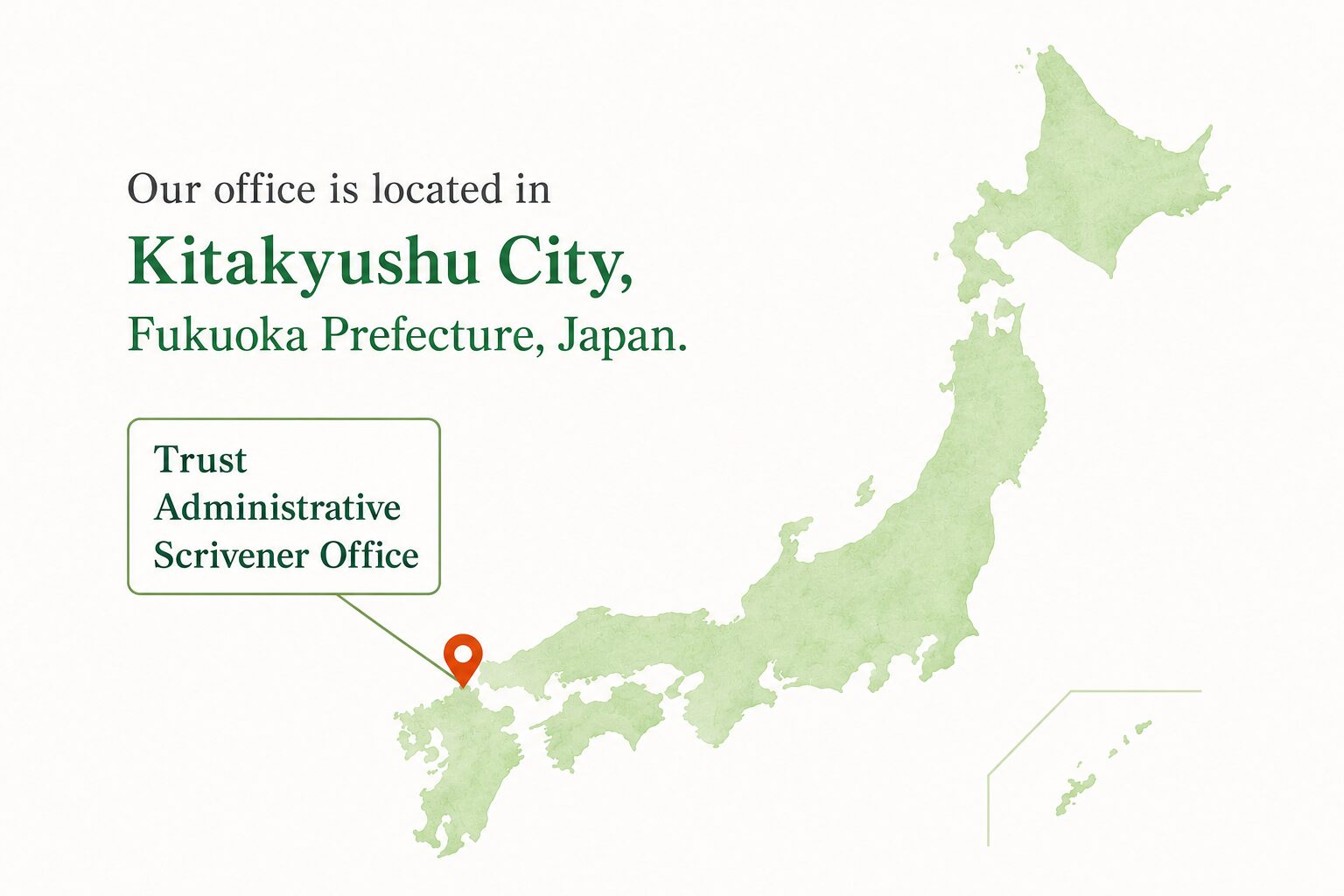
Trust Administrative Scrivener Office
Based in Kitakyushu, Fukuoka, Japan | Online consultations available
Official References
- Immigration Services Agency: Guidelines for Permanent Residency Permission
- Immigration Services Agency: Permanent Residency Application
- Immigration Services Agency: Permanent Residency Application for Spouses of Japanese Nationals
- Immigration Services Agency: Q&A on the Appropriate Management of the Permanent Residency System