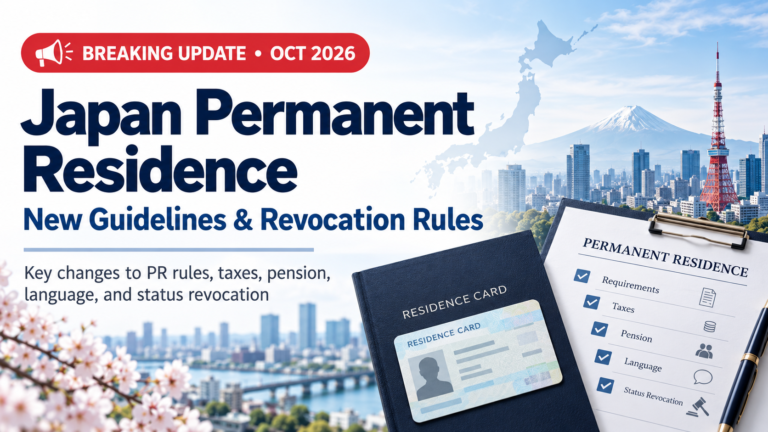
BREAKING UPDATE — OCTOBER 1, 2026
Japan Revises Permanent Residence Guidelines and Issues New Revocation Rules
On October 1, 2026, the Immigration Services Agency of Japan (ISA) published a major revision of its Permanent Residence Permission Guidelines.
On the same day, the ISA also published a new set of guidelines explaining how the new legal grounds for revoking Permanent Resident status will be interpreted and applied.
This is a preliminary breaking-news summary of the most important points. A more detailed practical guide will be published separately.
Important: Most of the New Rules Do Not Take Effect Immediately
The revised Permanent Residence guidelines will generally apply to applications filed on or after April 1, 2027.
However, certain provisions concerning household income and whether the applicant may become a public burden also apply to certain applications filed before that date and still pending on October 1, 2026.
The new guidelines concerning revocation of Permanent Resident status will also begin operation on April 1, 2027.
What Changed?
The revised Permanent Residence framework is much more detailed than the previous guidance.
Among the most important changes are clearer standards concerning household income, future pension income, financial assets, Japanese-language ability, understanding of Japanese rules and systems, school attendance of children, long absences from Japan, and the residence-period exception for spouses and children of Japanese nationals and Permanent Residents.
目次
- 1 1. Major Changes to Permanent Residence Requirements
- 1.1 Household income will be examined more specifically
- 1.2 Future pension income and financial assets will also matter
- 1.3 Japanese-language ability: B1 level becomes a consideration
- 1.4 Understanding Japanese systems and rules
- 1.5 School attendance of school-age children
- 1.6 Long periods outside Japan
- 1.7 The special residence-period rule for spouses will become stricter
- 1.8 Taxes, pension and health insurance remain extremely important
- 2 2. New Guidelines on Revocation of Permanent Resident Status
- 3 3. Government and Local Government Reporting
- 4 4. When Do the New Rules Apply?
- 5 5. What Should Permanent Residence Applicants Check Now?
- 6 Planning to Apply for Permanent Residence in Japan?
1. Major Changes to Permanent Residence Requirements
The following are some of the most important points in the revised guidelines.
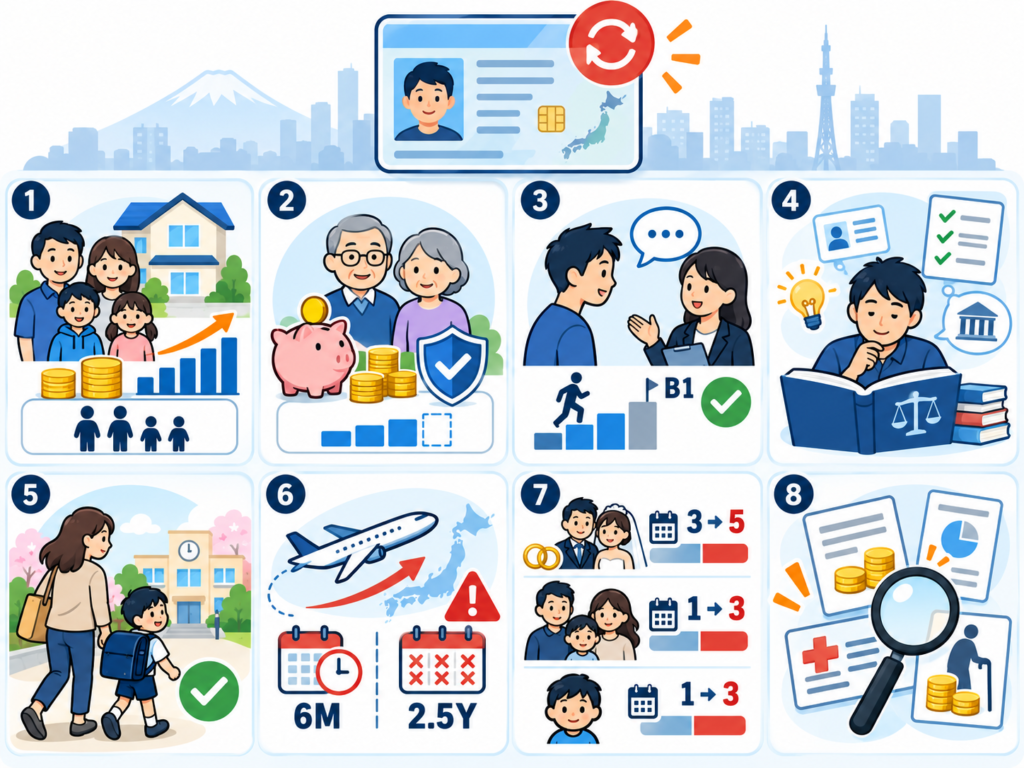
Household income will be examined more specifically
The revised guidelines state that, in principle, the applicant’s household annual income will be considered in comparison with the average income level of Japanese households of the same household size.
Income is generally assessed on a household basis, but not every family member’s income can necessarily be counted.
- Income of members of the same financial household may be combined in appropriate cases.
- Income earned under permission for activities outside the scope of status by a person holding a non-work status such as Dependent is generally not included.
- Relatives financially supported by the applicant, including relatives living outside Japan, may be counted when determining household size.
- Additional consideration applies to households of five or more persons.
Future pension income and financial assets will also matter
The new guidelines go beyond simply checking whether pension contributions have been properly paid.
The ISA may consider the applicant’s expected future pension benefits based on factors such as age, pension participation history, past employment status and income.
If the expected pension amount is below the relevant benchmark, sufficient financial assets may be taken into account to compensate for the shortfall.
Japanese-language ability: B1 level becomes a consideration
The revised guidelines state that applicants will generally be expected to have Japanese ability equivalent to B1 or higher under the Japanese Language Education Reference Framework.
Important: The guideline states B1 equivalent. It does not simply state that all applicants must hold a particular JLPT level. There are also categories of applicants for whom this Japanese-language factor may not be required.
Understanding Japanese systems and rules
Applicants may also be assessed on whether they understand Japanese systems and rules, including matters contained in the government’s Guidebook on Living and Working. The specific method of confirming this understanding will be designated by the Commissioner of the Immigration Services Agency.
School attendance of school-age children
If an applicant is raising a child of compulsory-school age, whether the child attends elementary or junior high school will become a factor in the Permanent Residence assessment.
Long periods outside Japan
The revised guidelines also provide clearer numerical guidance regarding absences from Japan.
Without a reasonable reason, an absence of six months or more in a single trip, or absences totaling two years and six months or more during the previous ten years, will generally be assessed negatively.
The special residence-period rule for spouses will become stricter
One particularly important change concerns the exception to the general ten-year residence rule for spouses of Japanese nationals, Permanent Residents and Special Permanent Residents.
| Rule | Previous Guideline | Revised Guideline |
|---|---|---|
| Spouse | Marriage for 3+ years and residence in Japan for 1+ year | Marriage for 5+ years and residence in Japan for 3+ years |
| Biological child, etc. | Residence in Japan for 1+ year | Residence in Japan for 3+ years |
Taxes, pension and health insurance remain extremely important
The revised guidelines provide more detailed treatment of taxes and other public charges, including income tax, residence tax, corporate tax, fixed-asset tax, public health insurance premiums and public pension contributions.
These matters are generally assessed on a household basis, and past payment problems may also be considered.
2. New Guidelines on Revocation of Permanent Resident Status
The ISA also issued a separate new guideline explaining how the new statutory grounds for revoking Permanent Resident status will operate.
The new framework concerns three main categories.
- Failure to comply with certain obligations under the Immigration Control Act;
- Intentionally failing to pay taxes or other public charges; and
- Being sentenced to imprisonment for certain specified criminal offences.
Important: Revocation Is Not Automatic
Even if a Permanent Resident falls within one of the new statutory grounds, the status is not automatically revoked.
The circumstances leading to the violation, subsequent conduct, the person’s ties to Japan, family situation and other individual circumstances must be considered.
Unless continued residence in Japan is considered inappropriate, the Minister of Justice is expected to change the person’s status of residence by official authority rather than immediately requiring departure from Japan. The guideline states that, in many such cases, a change to Long-Term Resident status is anticipated.
Simply having unpaid taxes does not automatically mean revocation
The statutory ground concerns a person who intentionally fails to pay taxes or other public charges.
The ISA explains that the focus is on cases where the person knows that payment is required but deliberately chooses not to pay, and where the lack of intention to pay is clear from the overall circumstances.
Factors may include:
- the amount of arrears;
- how long the arrears continued;
- how many times non-payment occurred;
- the person’s income, assets and financial situation;
- responses to notices and collection procedures;
- whether installment payments or deferment arrangements were followed; and
- the circumstances leading to non-payment.
The guideline expressly gives examples such as illness, disaster or unemployment as circumstances in which inability to pay may not fall within the intentional non-payment ground.
Immigration-law obligations
Examples include obligations relating to carrying and presenting a residence card and applying to renew or reissue a residence card when required.
Importantly, the guideline states that even negligent non-compliance can technically fall within the statutory ground. However, a single instance such as accidentally forgetting to carry a residence card or forgetting a renewal is not expected by itself to result in revocation.
Certain criminal convictions
The new statutory ground does not apply to every criminal offence.
It applies to imprisonment imposed for specified offences listed in the Immigration Control Act, including certain offences involving theft, robbery, fraud, extortion, assault, homicide, unlawful entry, document forgery and dangerous driving causing death or injury.
The guideline states that the length of the sentence does not determine whether this statutory ground is triggered, and a suspended sentence is also included.
3. Government and Local Government Reporting
The amended law also allows national and local government officials to report information to the ISA when, in the course of their official duties, they become aware of facts suggesting that a foreign national may fall within a ground for revocation.
A report does not mean automatic revocation. The ISA must investigate the facts, hear the foreign national’s explanation where required, and determine whether a statutory ground actually exists before the Minister of Justice makes a final decision.
4. When Do the New Rules Apply?
| Date | What It Means |
|---|---|
| October 1, 2026 | ISA publishes the revised Permanent Residence guidelines and the new revocation guidelines. |
| Applications already pending on October 1, 2026 | Certain new provisions concerning household income and public burden may apply where the application was filed on or after April 1, 2026 and remained pending on October 1, 2026. |
| April 1, 2027 | The revised Permanent Residence guidelines generally apply to new applications. Operation of the new revocation guidelines also begins. |
5. What Should Permanent Residence Applicants Check Now?
Anyone considering a Permanent Residence application should review their situation more broadly than before.
- household income and household size;
- tax payment history;
- pension and health-insurance payment history;
- future pension entitlement and financial assets;
- periods spent outside Japan during the previous ten years;
- Japanese-language ability;
- understanding of Japanese systems and rules;
- school attendance of compulsory-school-age children; and
- whether the required residence period will be satisfied under the revised rules.
Key Takeaway
Japan’s Permanent Residence framework is becoming significantly more detailed.
The October 1, 2026 revision introduces clearer standards relating to income, pension, financial assets, Japanese ability, social integration, residence history and family circumstances.
At the same time, the government has clarified how the new statutory grounds for revoking Permanent Resident status will operate. Importantly, the new framework does not mean that a single mistake, temporary inability to pay taxes, or a government report automatically results in the loss of Permanent Resident status.
Important Notice
This article is a preliminary summary based on the official guidelines published by the Immigration Services Agency of Japan on October 1, 2026.
Permanent Residence decisions are made based on the individual circumstances of each case. This article provides general information only and does not constitute an individual eligibility assessment or legal conclusion.
Official Sources
This breaking update is based on official information published by the Immigration Services Agency of Japan on October 1, 2026.
- Immigration Services Agency of Japan — Revised Permanent Residence Permission Guidelines (October 1, 2026)
- Immigration Services Agency of Japan — Guidelines on Revocation of Permanent Resident Status
Source checked: October 1, 2026. This article is an English practical summary of the official Japanese guidance and does not replace the original Japanese-language rules or guidelines.
PERMANENT RESIDENCE SUPPORT
Planning to Apply for Permanent Residence in Japan?
The revised guidelines require applicants to consider not only residence history, but also income, household composition, taxes, pension, social insurance, Japanese ability and other individual circumstances.
Trust Administrative Scrivener Office provides immigration and residence-status support for foreign nationals in Japan.
If you need advice based on your own residence history, family situation, income, tax or pension records, please book a paid consultation.
Trust Administrative Scrivener Office
Based in Kitakyushu, Fukuoka, we support foreign nationals with visa, residence status and official procedures in Japan.