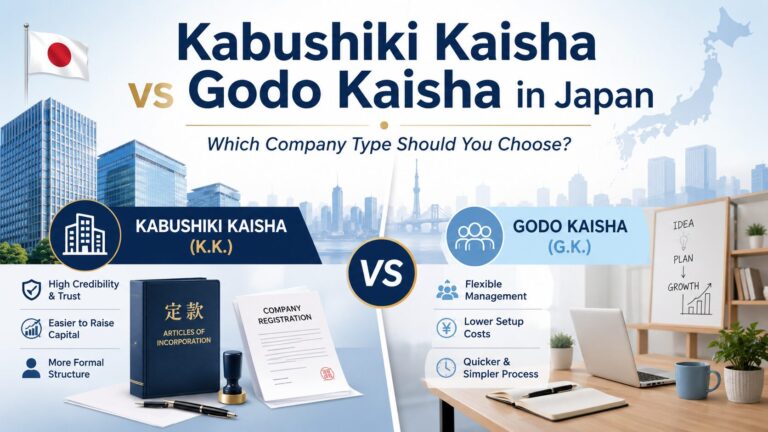
If you are starting a business in Japan, one of the first decisions you need to make is whether to establish a Kabushiki Kaisha or a Godo Kaisha.
For many foreign entrepreneurs, these two Japanese company types can be confusing at first.
A Kabushiki Kaisha, often abbreviated as K.K., is commonly translated as a joint-stock corporation or stock company. A Godo Kaisha, often abbreviated as G.K., is commonly translated as a limited liability company.
Both are legally recognized companies under Japanese law, and both can be used for business operations in Japan.
However, they are different in cost, credibility, management structure, flexibility, and suitability for future business expansion.
This article explains the main differences between Kabushiki Kaisha and Godo Kaisha, especially for foreign entrepreneurs who are considering starting a company in Japan or applying for a Business Manager Visa.
This article is for you if:
- You want to start a company in Japan
- You are choosing between Kabushiki Kaisha and Godo Kaisha
- You are a foreign entrepreneur planning to apply for a Business Manager Visa
- You want to understand company establishment costs in Japan
- You are not sure whether a K.K. or G.K. is better for your business
- You want to explain your company structure clearly to Immigration, banks, or business partners
Important point for foreign entrepreneurs
Choosing a company type is not the same as obtaining a visa.
You may establish either a Kabushiki Kaisha or a Godo Kaisha, but your visa application will be examined separately based on immigration requirements, your business plan, capital, office, management experience, Japanese language capacity, and other factors.
In other words, forming a company is only one part of the process. If your goal is to live in Japan as a business owner, you must also plan your residence status strategy carefully.
- 1 Types of Companies in Japan
- 2 What is a Kabushiki Kaisha?
- 3 What is a Godo Kaisha?
- 4 Kabushiki Kaisha vs Godo Kaisha: Comparison Table
- 5 Which is cheaper to establish?
- 6 Which looks more credible in Japan?
- 7 Which is better for foreign entrepreneurs?
- 8 Does company type affect the Business Manager Visa?
- 9 Practical examples
- 10 Common misunderstandings
- 11 Checklist before choosing K.K. or G.K.
- 12 Conclusion: Which should you choose?
- 13 Not sure which business visa route fits your plan?
- 14 Need help setting up a company in Japan?
Types of Companies in Japan
Under Japanese law, there are several types of companies.
The main types include:
- Kabushiki Kaisha (K.K.)
- Godo Kaisha (G.K.)
- Gomei Kaisha
- Goshi Kaisha
In practice, most foreign entrepreneurs who want to establish a company in Japan choose either a Kabushiki Kaisha or a Godo Kaisha.
Gomei Kaisha and Goshi Kaisha are rarely used in modern business practice because they involve unlimited liability for some or all members.
For that reason, this article focuses on the two most practical options: K.K. and G.K.
What is a Kabushiki Kaisha?
A Kabushiki Kaisha, or K.K., is a stock company under Japanese law.
It is the most traditional and widely recognized company form in Japan.
In a K.K., ownership is represented by shares. The owners are shareholders, and the company is managed by directors.
In larger companies, ownership and management are clearly separated. However, in small companies, especially one-person companies, the shareholder and the director are often the same person.
For example, a foreign entrepreneur may establish a K.K. where they are both the sole shareholder and the representative director.
Advantages of a Kabushiki Kaisha
- Higher recognition in Japan
K.K. is widely known and often seen as the standard company form in Japan. - Better impression for banks and business partners
Some Japanese companies, banks, landlords, and business partners may feel more familiar with a K.K. structure. - Suitable for future expansion
If you plan to raise investment, issue shares, bring in investors, or grow into a larger company, a K.K. may be easier to explain. - Useful for credibility-sensitive businesses
If your business depends heavily on trust, corporate image, or B2B relationships, a K.K. may give a stronger impression.
Disadvantages of a Kabushiki Kaisha
- Higher establishment cost
Establishing a K.K. usually costs more than establishing a G.K. because notarization of the articles of incorporation is required and the registration tax is higher. - More formal procedures
A K.K. has more formal corporate governance rules, including shareholders’ meetings and director-related procedures. - Public notice of financial statements
In principle, a K.K. must publicly announce its financial statements. - Director term management
Directors have terms of office. In a non-public company, the term can generally be extended up to 10 years, but reappointment registration may still be needed when the term expires.
What is a Godo Kaisha?
A Godo Kaisha, or G.K., is a limited liability company under Japanese law.
It is a type of membership company. In a G.K., the investors are called “members.” This word does not mean employees. It refers to the owners of the company.
In principle, the members of a G.K. directly manage the company, although the articles of incorporation can designate specific members to execute business.
A G.K. is often chosen by small businesses, solo entrepreneurs, family businesses, online businesses, consulting businesses, and foreign entrepreneurs who want to reduce establishment costs.
Advantages of a Godo Kaisha
- Lower establishment cost
A G.K. does not require notarization of the articles of incorporation, and the minimum registration tax is lower than that of a K.K. - Flexible management
A G.K. can be operated more flexibly than a K.K., especially when there are only one or a few members. - No director term management
A G.K. does not have the same director term system as a K.K., so there is no periodic reappointment registration for directors. - No public notice of financial statements
Unlike a K.K., a G.K. is generally not required to publicly announce financial statements. - Suitable for small and lean businesses
If your business is small, owner-managed, and does not require outside investors, a G.K. may be practical.
Disadvantages of a Godo Kaisha
- Lower name recognition in Japan
G.K. is legally valid, but some people are still less familiar with it than K.K. - May look smaller or less established
Depending on your industry, a G.K. may give the impression of a small business. - Not suitable for issuing shares
A G.K. cannot raise funds by issuing shares like a K.K. - Member disputes can become serious
If there are multiple members and the articles of incorporation are not carefully prepared, disagreements among members can create management problems.
Kabushiki Kaisha vs Godo Kaisha: Comparison Table
The following table summarizes the main differences between K.K. and G.K.
| Item | Kabushiki Kaisha (K.K.) | Godo Kaisha (G.K.) |
|---|---|---|
| Legal nature | Stock company | Limited liability company / membership company |
| Owners | Shareholders | Members |
| Management | Directors manage the company | Members generally manage the company, unless otherwise provided |
| Representative title | Representative Director | Representative Member |
| Credibility / recognition | Generally higher recognition in Japan | Legally valid but less familiar to some people |
| Articles of incorporation notarization | Required | Not required |
| Minimum registration tax | Generally 150,000 yen | Generally 60,000 yen |
| Public notice of financial statements | Required in principle | Not required in the same way |
| Director / officer term | Directors have terms of office | No director term system like a K.K. |
| Profit distribution | Generally based on shares | Can be flexibly provided in the articles of incorporation |
| Fundraising | Can issue shares | Cannot issue shares |
| Best suited for | Businesses seeking credibility, expansion, investors, or B2B trust | Small businesses, solo founders, family businesses, and cost-conscious startups |
Which is cheaper to establish?
In general, a Godo Kaisha is cheaper to establish than a Kabushiki Kaisha.
The main reasons are:
- A G.K. does not require notarization of the articles of incorporation.
- The minimum registration tax for a G.K. is lower.
- A G.K. usually has simpler internal governance.
For a simple company structure, the government-related establishment cost is usually lower for a G.K.
However, cost should not be the only reason for choosing a company type.
If your business requires strong external credibility, bank financing, Japanese corporate clients, or future investment, a K.K. may be more suitable even if the establishment cost is higher.
Which looks more credible in Japan?
In Japan, Kabushiki Kaisha generally has higher name recognition.
Many large Japanese companies are K.K.s, and many Japanese people are more familiar with the term “Kabushiki Kaisha.”
For this reason, a K.K. may look more formal and established to Japanese banks, landlords, suppliers, and corporate clients.
However, this does not mean that a G.K. is unreliable.
Many legitimate businesses operate as G.K.s. Some major global companies also use the G.K. structure in Japan.
The real question is not whether G.K. is “bad.”
The better question is: What impression do you want to give to your customers, business partners, banks, landlords, and Immigration?
Which is better for foreign entrepreneurs?
There is no single answer.
The better choice depends on your business plan, budget, visa strategy, industry, and future growth plan.
A Kabushiki Kaisha may be better if:
- You want stronger credibility in Japan
- You plan to work with Japanese corporate clients
- You may seek investors in the future
- You want a more familiar company form for banks and landlords
- You want your company to look more formal from the start
- You plan to grow the company beyond a small owner-managed business
A Godo Kaisha may be better if:
- You want to reduce establishment costs
- You are starting a small business
- You are the only founder or there are only a few trusted members
- You do not plan to issue shares or raise investment soon
- You want a simple management structure
- You prioritize speed and flexibility over public image

Planning a Startup Visa or Business Manager Visa?
Try our free Japan Business Visa Route Navigator first.
This interactive tool helps you understand which visa route may be suitable for your situation
and gives you a general idea of our support fees.
If you need personalized advice, you can book a paid consultation afterward.
Does company type affect the Business Manager Visa?
Company type can affect the overall impression and practical preparation, but it is not the only factor in a Business Manager Visa application.
Immigration will not approve a Business Manager Visa simply because you established a Kabushiki Kaisha.
Likewise, establishing a Godo Kaisha does not automatically make your application weak.
Immigration will look at the substance of your business.
Important points may include:
- Whether the business is realistic and continuous
- Whether the business scale meets the current immigration standards
- Whether the office is properly secured
- Whether the capital or business assets are sufficient
- Whether the business plan is detailed and credible
- Whether there is a clear revenue model
- Whether management experience, education, or business background supports the plan
- Whether Japanese language capacity or staff structure satisfies the current requirements
Important update for Business Manager Visa
After the 2025 amendment, the Business Manager Visa requirements became much stricter than before.
In many cases, the business must now be planned with a much larger business scale than the old “5 million yen” standard.
Before establishing a company, foreign entrepreneurs should check not only company law requirements but also immigration requirements.
Practical examples
Example 1: Solo consultant
A foreign entrepreneur wants to provide consulting services in Japan with a small initial budget.
They do not plan to hire many employees or raise investment immediately.
In this case, a G.K. may be practical because it is simple and cost-effective.
However, if the person needs to apply for a Business Manager Visa, the business scale and office requirements must still be carefully examined.
Example 2: Company targeting Japanese corporate clients
A foreign entrepreneur wants to provide B2B services to Japanese companies.
They want strong credibility when approaching banks, landlords, and corporate clients.
In this case, a K.K. may be more suitable because it is more familiar and formal in Japan.
Example 3: Startup planning to bring in investors
A founder plans to raise funds from investors in the future.
They may need to issue shares, adjust ownership percentages, and prepare for future expansion.
In this case, a K.K. is usually easier to structure and explain.
Example 4: Family business or small online business
A small family business or online service business may not need external investors or a complex governance structure.
In this case, a G.K. may be sufficient.
However, if the business is connected to a visa application, Immigration strategy should be reviewed before incorporation.
Common misunderstandings
Misunderstanding 1
“A K.K. is always better.” This is not always true. A G.K. may be better for a small, owner-managed business.
Misunderstanding 2
“A G.K. is not a real company.” This is incorrect. A G.K. is a legal company form under Japanese law.
Misunderstanding 3
“If I establish a company, I can get a visa.” This is incorrect. Company establishment and visa approval are different procedures.
Misunderstanding 4
“The cheapest company type is always the best.” This may create problems later if credibility, investment, or visa strategy is important.
Checklist before choosing K.K. or G.K.
Before deciding your company type, consider the following questions:
- Do you need strong credibility with Japanese companies or banks?
- Will you seek investment in the future?
- Will you have co-founders or outside investors?
- Is your business small and owner-managed?
- Is reducing initial cost important?
- Do you need a company mainly for Business Manager Visa purposes?
- Will you need a physical office in Japan?
- Do you understand the current Business Manager Visa requirements?
- Do you have a realistic business plan and revenue model?
- Do you need support in English?
If your answer involves immigration strategy, it is better to review the visa route before establishing the company.
Changing the company structure later is possible in some cases, but it can create additional time, cost, and complications.
Conclusion: Which should you choose?
If you want a simple answer:
- Choose Kabushiki Kaisha if credibility, investors, B2B trust, or future expansion are important.
- Choose Godo Kaisha if you want a lower-cost, simpler, owner-managed structure.
However, for foreign entrepreneurs, the decision should not be based only on company law or setup cost.
You should also consider your visa route, business scale, office plan, funding source, revenue plan, and long-term business strategy in Japan.
Especially if you are considering the Business Manager Visa, company establishment should be planned together with immigration strategy.
FREE SELF-CHECK TOOL
Not sure which business visa route fits your plan?
Before establishing a company, you can use our Japan Business Visa Navigator to organize your possible visa route, such as Startup Visa, Business Manager Visa, or Highly Skilled Professional Visa.
This tool provides a preliminary overview only. It is not legal advice and does not guarantee visa approval.
PROFESSIONAL SUPPORT
Need help setting up a company in Japan?
Trust Administrative Scrivener Office supports foreign entrepreneurs with company establishment planning, Business Manager Visa strategy, Startup Visa support, and related immigration procedures in Japan.
We do not provide individual case judgments by free email, LINE, or contact form messages.
If you need advice for your specific business and visa situation, please book a paid consultation.
Trust Administrative Scrivener Office
Based in Kitakyushu, Fukuoka, we support foreign entrepreneurs with visa, residence status, company setup planning, and official procedures in Japan.