Japan’s Immigration Fee Reform: Permanent Residence Application Fees May Rise Significantly
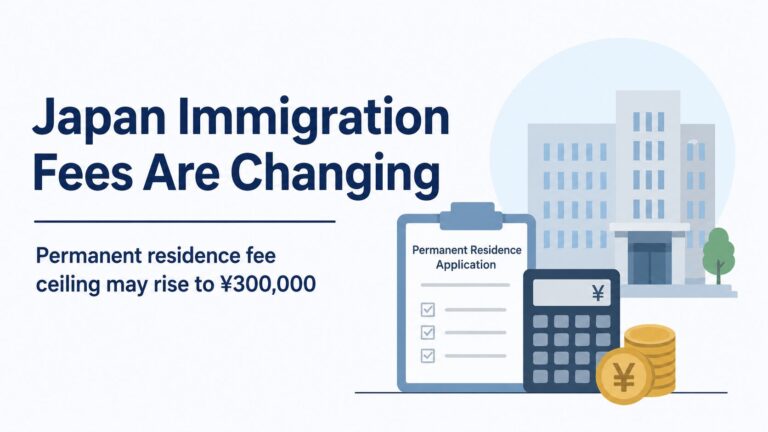
As of May 29, 2026, it has been reported that a bill to amend Japan’s Immigration Control and Refugee Recognition Act has been passed by the House of Councillors and enacted. One of the most important points in this reform is the substantial increase in the statutory upper limits for certain immigration-related fees, including the fee for permission for permanent residence.
For foreign residents in Japan, this reform may have a significant practical impact. However, it is important to understand the difference between the “statutory upper limit” and the “actual fee” that applicants will be required to pay.
Key point:
The new law raises the legal maximum amount that may be charged. It does not necessarily mean that every applicant will immediately be required to pay the maximum amount.
- 1 1. What Has Changed?
- 2 2. Does This Mean Every Permanent Residence Applicant Must Pay 300,000 Yen?
- 3 3. Current Permanent Residence Application Fee
- 4 4. Why This Reform Matters for Foreign Residents
- 5 5. Permanent Residence Screening Is Also Becoming More Strict
- 6 6. Important Change from April 1, 2027: “Maximum Period of Stay”
- 7 7. What Applicants Should Do Now
- 8 8. JESTA: Japan’s New Electronic Travel Authorization System
- 9 9. Administrative Scrivener’s Perspective
- 10 10. Conclusion
- 11 Need Help with a Permanent Residence Application in Japan?
- 12 Official Sources
1. What Has Changed?
According to materials published by the Immigration Services Agency of Japan, the statutory upper limits for certain residence-related procedures will be raised as follows.
| Procedure | Previous statutory upper limit | New statutory upper limit |
|---|---|---|
| Change of status of residence | 10,000 yen | 100,000 yen |
| Extension of period of stay | 10,000 yen | 100,000 yen |
| Permission for permanent residence | 10,000 yen | 300,000 yen |
This means that the statutory ceiling for permanent residence permission will become 30 times higher than before.
2. Does This Mean Every Permanent Residence Applicant Must Pay 300,000 Yen?
No. The new law raises the legal upper limit, but it does not automatically mean that every applicant will be required to pay 300,000 yen.
The actual amount to be collected will be determined separately by Cabinet Order. Therefore, at this stage, it is safer and more accurate to say that the government has raised the maximum legal ceiling for the fee, while the actual fee must be confirmed through the relevant Cabinet Order and official announcements.
Important:
“300,000 yen” is the statutory upper limit for permanent residence permission. The actual fee may be lower depending on the Cabinet Order.
3. Current Permanent Residence Application Fee
As of the latest information available on the Immigration Services Agency’s official website, the current fee for permission for permanent residence is 10,000 yen, payable by revenue stamp when permission is granted.
The Immigration Services Agency also explains that no fee is required in cases where a person acquires permanent resident status due to birth or other similar circumstances, as opposed to changing from another status of residence to permanent resident status.
4. Why This Reform Matters for Foreign Residents
Permanent residence is one of the most important statuses for foreign residents who wish to build a stable long-term life in Japan. A permanent resident is not subject to restrictions on activities or period of stay in the same way as many other residence statuses.
For this reason, permanent residence can provide greater stability for employment, family life, housing, business management, and long-term financial planning.
If the actual government fee rises significantly in the future, applicants will need to consider not only whether they meet the legal requirements, but also the timing and financial burden of the application.
This reform may especially affect the following applicants:
- foreign residents who are already close to meeting the permanent residence requirements;
- spouses of Japanese nationals or permanent residents;
- long-term workers in Japan;
- highly skilled professionals considering an early permanent residence application;
- families applying together; and
- foreign entrepreneurs and business owners planning their long-term residence strategy in Japan.
5. Permanent Residence Screening Is Also Becoming More Strict
The fee increase should not be viewed separately from the broader trend in Japan’s immigration practice. Permanent residence applications are examined carefully, especially regarding tax payments, pension payments, health insurance contributions, income stability, and compliance with immigration-related obligations.
The official Guidelines for Permission for Permanent Residence, revised on February 24, 2026, state that applicants are generally required to satisfy the following basic requirements:
- good conduct;
- sufficient assets or ability to make an independent living; and
- recognition that granting permanent residence is in the interests of Japan.
The Guidelines also emphasize the importance of properly fulfilling public obligations, including tax, public pension, public health insurance premiums, and notifications required under the Immigration Control Act.
Administrative scrivener’s practical point:
Before applying for permanent residence, applicants should carefully check their tax records, pension records, health insurance payment history, residence status history, and notification obligations.
6. Important Change from April 1, 2027: “Maximum Period of Stay”
The Immigration Services Agency has also announced an important change concerning the period of stay requirement for permanent residence applications.
Until now, in practice, applicants with a three-year period of stay could often be treated as satisfying the requirement of holding the “maximum period of stay.” However, according to the Immigration Services Agency’s notice, from April 1, 2027, the requirement will be applied according to the wording of the Guidelines: the applicant must hold the maximum period of stay provided for their status of residence.
This means that, depending on the applicant’s status of residence, having a three-year period of stay may no longer be sufficient after the change takes effect.
Practical note:
Applicants who currently hold a three-year period of stay should carefully check whether they can apply before the new handling begins, or whether they need to obtain the maximum period of stay first.
7. What Applicants Should Do Now
1. Check whether you already meet the basic requirements
Applicants should not apply simply because government fees may increase. Permanent residence applications are document-heavy and are examined carefully. The first step is to confirm whether you meet the residence period requirement, income requirement, tax and social insurance requirements, and other relevant conditions.
2. Review your tax, pension, and health insurance records
Late payments or missing payments can have a serious negative impact on a permanent residence application. This is especially important for company owners, sole proprietors, freelancers, and applicants whose income or payment records are not straightforward.
3. Consider the timing of your application
If you already satisfy the requirements and your documents are ready, it may be worth considering whether to apply before the new fee structure is implemented. However, timing should be decided based on eligibility and document readiness, not only on the fee issue.
4. Wait for the official Cabinet Order for the exact fee amount
At this stage, the exact amount of the new fee must be confirmed through the Cabinet Order and official announcements. Applicants should be careful not to rely only on headlines stating “300,000 yen,” because that amount refers to the legal upper limit.
8. JESTA: Japan’s New Electronic Travel Authorization System
The same reform also includes the creation of an electronic travel authorization system, commonly referred to as JESTA. This system is often described as Japan’s version of the U.S. ESTA system.
Under JESTA, certain foreign nationals who intend to travel to Japan may be required to submit information online before traveling. The purpose is to screen travelers in advance and prevent the entry of persons who may be considered undesirable from the perspective of border control.
JESTA is mainly relevant to short-term visitors from visa-exempt countries and regions. It is separate from permanent residence applications, but it reflects the same broader policy trend: Japan is moving toward more digitalized and stricter immigration screening.
9. Administrative Scrivener’s Perspective
From the perspective of an administrative scrivener handling immigration procedures, this reform has two major meanings.
First, applicants will need to plan permanent residence applications more carefully. If the government fee becomes much higher, an incomplete or poorly prepared application will carry greater financial risk.
Second, the importance of document accuracy will increase. Permanent residence applications are not approved simply because a person has lived in Japan for a long time. Immigration examines the applicant’s overall residence history, income stability, tax and social insurance compliance, family situation, and whether granting permanent residence is considered appropriate for Japan.
For this reason, foreign residents should avoid applying casually without checking their records. A careful review before application is becoming more important than ever.
10. Conclusion
Japan’s 2026 amendment to the Immigration Control and Refugee Recognition Act marks a major change in immigration-related fees. The statutory upper limit for permission for permanent residence will be raised from 10,000 yen to 300,000 yen, while the upper limits for change of status and extension of period of stay will be raised to 100,000 yen.
However, applicants should not misunderstand the reform. The 300,000 yen figure is the maximum legal ceiling, not necessarily the exact amount that every applicant will pay. The actual fee will be determined by Cabinet Order.
For those who are considering permanent residence in Japan, the key message is clear: check your eligibility, review your tax and social insurance records, prepare your documents carefully, and follow official updates closely.
Permanent residence remains one of the most important immigration goals for foreign residents who wish to build a long-term life in Japan. Because the system is becoming stricter and potentially more costly, proper preparation is essential.
Need Help with a Permanent Residence Application in Japan?
Trust Administrative Scrivener Office provides support for visa and immigration procedures in Japan, including permanent residence applications, status changes, and residence period renewals.
Before applying, it is important to check whether your tax, pension, health insurance, income, residence history, and other records are suitable for a permanent residence application.
If you would like to consult with our office, please check our consultation page first.
Official Sources
- Immigration Services Agency of Japan, “Raising the statutory upper limits for immigration-related fees”
- Immigration Services Agency of Japan, “Application for Permanent Residence”
- Immigration Services Agency of Japan, “Permanent Residence Permission”
- Immigration Services Agency of Japan, “Guidelines for Permission for Permanent Residence, revised February 24, 2026”
https://www.moj.go.jp/isa/applications/resources/nyukan_nyukan50.html
- Immigration Services Agency of Japan, materials concerning JESTA and immigration administration
This article is based on information available as of May 29, 2026. The actual government fees may be determined or changed by Cabinet Order or other official announcements. Please check the latest official information before applying.