
The Japan Foundation has announced an important update to the Japanese-Language Proficiency Test (JLPT).
Starting with the December 2025 JLPT, official score reports will include a reference CEFR level for successful candidates.
This change helps learners, employers, and educational institutions better understand what a JLPT result means in an international context.
What Is CEFR?
CEFR (Common European Framework of Reference for Languages) is an international standard used to describe language proficiency.
It divides language ability into six levels:
-
A1 / A2 – Basic user
-
B1 / B2 – Independent user
-
C1 / C2 – Proficient user
CEFR is widely used for English and European languages and is increasingly used as a global reference for language ability.
Why Is CEFR Being Added to JLPT Results?
Until now, JLPT results were shown only as N5 to N1, which can be difficult to interpret outside Japan.
By adding a CEFR reference level:
-
Learners can better explain their Japanese ability internationally
-
Employers and schools can more easily compare Japanese proficiency with other languages
-
JLPT results become easier to understand for non-Japanese audiences
This change does not replace JLPT levels — it simply adds CEFR as reference information.
How JLPT Scores Correspond to CEFR Levels
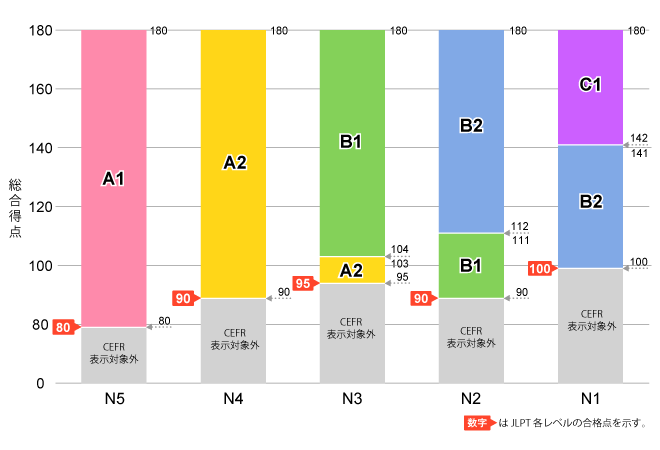
From the December 2025 test onward, CEFR levels will be shown only for candidates who pass the JLPT.
Overview of CEFR Reference Levels
-
N5 → A1
-
N4 → A2
For higher levels, CEFR references depend on the total score:
-
N3
-
Lower passing scores → A2
-
Higher scores → B1
-
-
N2
-
Lower passing scores → B1
-
Higher scores → B2
-
-
N1
-
Lower passing scores → B2
-
Higher scores → C1
-
If a candidate does not pass, the CEFR level will not be displayed.
The chart below is provided by The Japan Foundation and is shown here for reference purposes only.
It illustrates how JLPT total scores correspond to CEFR levels.
 Source: The Japan Foundation Copyright © The Japan Foundation

Want to improve your Japanese?
Depending on your visa type and life in Japan, Japanese language ability may not always be legally required.
However, Japanese can be extremely helpful for daily life, communication, administrative procedures, work, banking, and building your life in Japan.
If you would like to improve your Japanese conversation skills or study practical Japanese for real life in Japan, online Japanese lessons are also available.
Important Limitations to Understand
The CEFR reference shown in JLPT results reflects only:
-
Language knowledge
-
Reading ability
-
Listening ability
It does not evaluate:
-
Speaking
-
Writing
-
Interactive communication skills
In CEFR terms, JLPT corresponds mainly to receptive skills (reading and listening), not productive skills.
What This Means for Japanese Learners
This update makes JLPT results more transparent and internationally comparable.
However, it is important to remember:
-
CEFR levels are reference indicators, not full proficiency evaluations
-
Real-world Japanese ability still depends on speaking, writing, and practical use
JLPT remains a valuable benchmark, and the addition of CEFR makes it easier to explain Japanese ability in global settings.
Final Thoughts
The addition of CEFR reference levels is a positive step toward aligning Japanese language testing with international standards.
For learners, it provides clearer positioning.
For employers and institutions, it offers better comparability.
Understanding both JLPT levels and CEFR references will become increasingly important going forward.
Language Support for JLPT Preparation
The representative of Trust Administrative Scrivener Office is also a certified Japanese language teacher with experience in JLPT preparation.
Based on this background, our representative is able to provide JLPT-focused Japanese lessons when necessary, particularly for learners who wish to strengthen their reading and listening skills in a practical and structured manner.
This combined expertise allows the office to support clients not only with visa- and residency-related procedures, but also with the language preparation that often underlies long-term plans for living and working in Japan.
PROFESSIONAL SUPPORT
Need professional advice?
If you need individual advice regarding Japanese visas, residence status, company setup, permits, or official document procedures, please book a paid consultation.
We do not provide individual case assessments through free blog comments, general contact forms, or social media messages.
All consultations require advance booking and advance payment.
Trust Administrative Scrivener Office
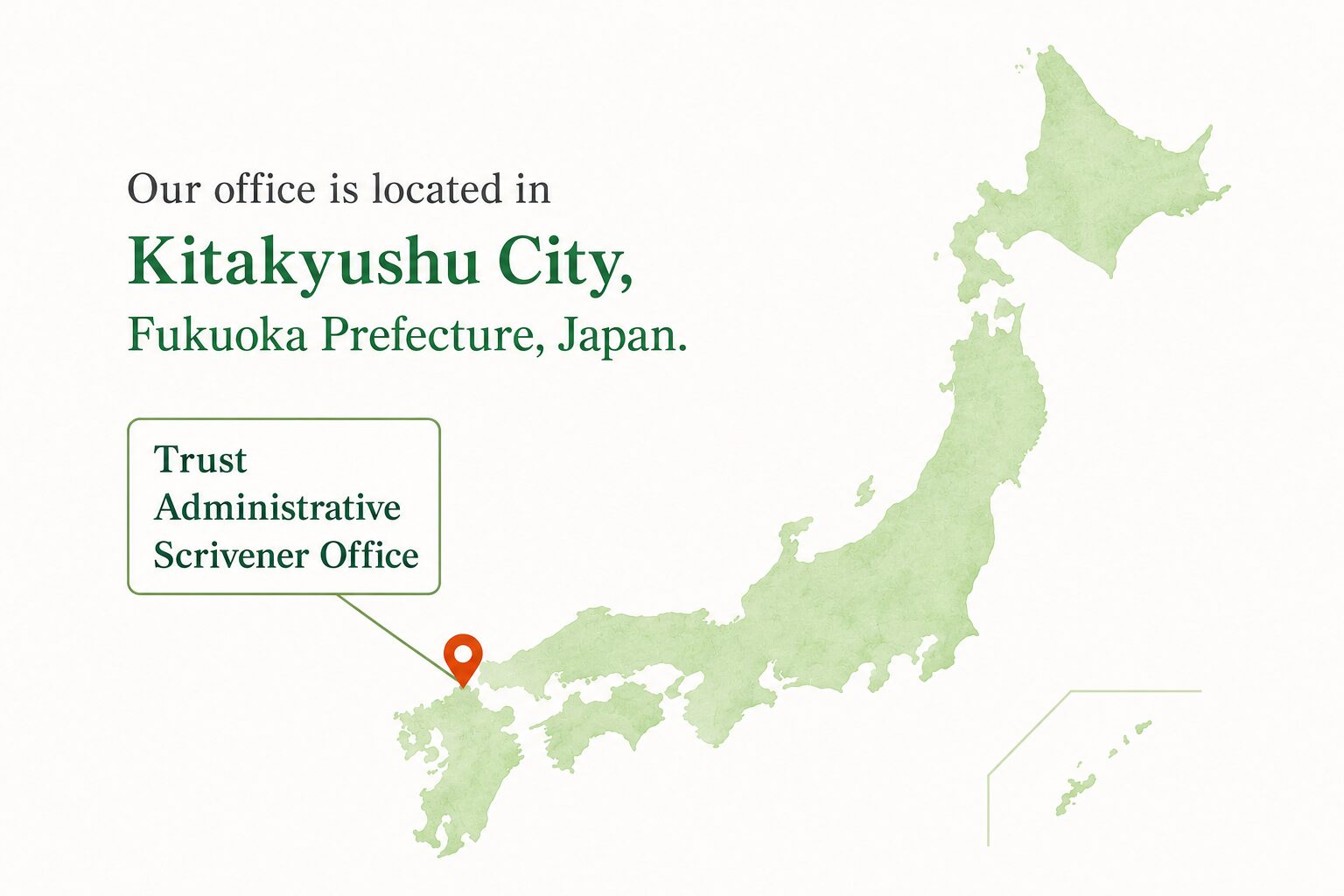
Based in Kitakyushu, Fukuoka, Japan | Online consultations available