UPDATED FOR THE OCTOBER 2026 GUIDELINES
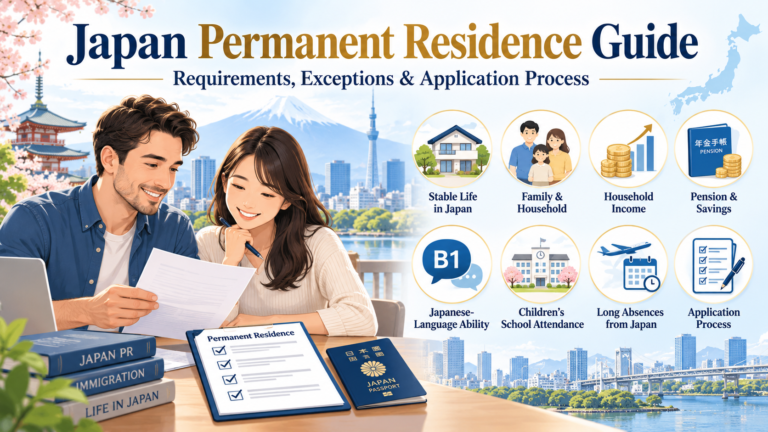
Japan Permanent Residence (PR): Requirements, Exceptions and Application Process
Permanent Residence is one of the most stable residence statuses available to foreign nationals living in Japan.
Unlike ordinary work or family-based residence statuses, Permanent Resident status has no restriction on the type of activity you may engage in and no period of stay that must be renewed.
However, Permanent Residence is subject to careful examination. On October 1, 2026, the Immigration Services Agency of Japan (ISA) substantially revised its Permanent Residence guidelines, introducing more detailed standards concerning income, pension, Japanese-language ability, periods spent outside Japan, family circumstances and other factors.
Important: When Do the New Guidelines Apply?
The revised guidelines published on October 1, 2026 will generally apply to Permanent Residence applications filed on or after April 1, 2027.
Applications filed on or before March 31, 2026 continue to be reviewed under the previous February 24, 2026 guidelines.
For certain applications filed from April 1, 2026 and still pending on October 1, 2026, some of the new provisions concerning household income and public burden may already apply.
1. What Is Permanent Residence in Japan?
Permanent Residence is permission granted by the Minister of Justice to a foreign national who wishes to change from their current residence status to the status of Permanent Resident.
A Permanent Resident may remain in Japan without a fixed period of stay and is not restricted to a specific category of work or activity.
Main Advantages of Permanent Residence
- No restriction on the type of employment or business activity
- No extension of the period of stay is required
- Greater long-term stability for living and working in Japan
- The ability to change jobs or start a business without changing residence status
Note: Permanent Residents still hold a residence card, and the card itself must be renewed when required. Permanent Residence also does not mean Japanese citizenship.
2. The Three Basic Requirements for Permanent Residence
Article 22 of the Immigration Control and Refugee Recognition Act provides three basic elements that are relevant to Permanent Residence.
1. Good conduct
The applicant must observe Japanese law and generally conduct daily life in a manner that is not socially blameworthy.
Repeated unlawful conduct, serious criminal matters, or repeated problematic behavior may negatively affect the application.
2. Ability to maintain an independent and stable livelihood
The applicant must generally be able to maintain a stable life in Japan without becoming a public burden.
Under the revised guidelines, this assessment is increasingly made by considering the applicant’s household as a whole, including income, household size, financial circumstances, future pension benefits and other relevant factors.
3. Permanent Residence must be considered in Japan’s interests
This is a broad requirement.
Factors include the applicant’s residence history, compliance with immigration obligations, payment of taxes and social insurance, criminal record, current residence status, periods spent outside Japan, economic situation and other circumstances.
The revised guidelines also expressly identify Japanese-language ability, understanding of Japanese systems and rules, and school attendance of compulsory-school-age children as relevant factors in appropriate cases.
3. The General 10-Year Residence Rule
As a general rule, the applicant should have continuously resided in Japan for at least 10 years.
Within this period, the guidelines generally require:
- at least 10 continuous years of residence in Japan; and
- at least 5 continuous years under a qualifying work status or residence-based status.
Not every period spent in Japan under every type of residence status is treated in the same way. Certain Designated Activities and temporary or transitional activities may not count toward the required period.
4. What Changes Under the October 2026 Guidelines?
The revised guidelines provide much more detail about how Permanent Residence applications will be assessed.
Household income
In principle, the applicant’s household annual income will be considered against an income level based on the average income of Japanese households of a comparable household size.
This means that the assessment is not simply based on one fixed annual-income figure.
- Household size matters.
- Income of appropriate household members may be combined.
- Income earned through limited activities outside the scope of a non-work status such as Dependent is generally not counted.
- Dependents living outside Japan may still affect household-size calculations.
Future pension benefits and financial assets
The revised guidelines go beyond checking whether pension contributions have simply been paid.
The applicant’s pension participation history and estimated future pension benefits may also be considered. Where expected pension income is below the relevant benchmark, sufficient financial assets may be considered as a means of supplementing the shortfall.
Taxes, pension and public health insurance
Proper payment of public obligations remains extremely important.
This includes taxes as well as public pension and health-insurance contributions. Past payment history may be relevant even if there are no unpaid amounts at the time of application.
Japanese-language ability: B1 equivalent
The revised guidelines state that, in principle, Japanese-language ability equivalent to B1 or higher under the Japanese Language Education Reference Framework will be considered.
Important: The guideline uses the standard “B1 equivalent.” It does not simply state that every applicant must possess a particular JLPT certificate. Certain categories of applicants may also be exempt from this consideration.
Understanding Japanese systems and rules
Applicants may be assessed on their understanding of Japanese systems and rules, including matters covered in the government’s Guidebook on Living and Working. The specific confirmation method will be designated by the Immigration Services Agency.
School attendance of children
Where an applicant is raising a child of compulsory-school age, whether the child attends elementary or junior high school will be considered.
Long periods outside Japan
The revised guidelines provide specific numerical guidance regarding long absences from Japan.
Without a reasonable reason, the following will generally be negatively assessed:
- a single absence from Japan of six months or more; or
- total absences of two years and six months or more during the previous ten years.
Longest period of stay
As a general rule, the applicant must hold the longest period of stay available for the current residence status.
Transitional rules apply to applicants holding a three-year period of stay around the April 1, 2027 implementation date, so the timing of the application may be important.
5. Exceptions to the General 10-Year Residence Rule
The 10-year rule does not apply in exactly the same way to every applicant.
Spouse of a Japanese national, Permanent Resident or Special Permanent Resident
Under the revised guideline applicable from April 1, 2027, the applicant must generally have:
- a genuine marital relationship continuing for at least 5 years; and
- continuous residence in Japan for at least 3 years.
Biological child, etc.
A qualifying biological child, etc. must generally have continuously resided in Japan for at least 3 years under the revised guideline.
Long-Term Resident
A person holding Long-Term Resident status may qualify for the residence-period exception after generally residing continuously in Japan under that status for at least 5 years.
Recognized refugee or person granted complementary protection
A person recognized as a refugee or granted complementary protection may qualify after generally residing continuously in Japan for at least 5 years after recognition.
Highly Skilled Professionals
| Category |
General Residence Period |
| 70+ Highly Skilled Professional points |
Generally 3 years |
| 80+ Highly Skilled Professional points |
Generally 1 year |
| Special Highly Skilled Professional (J-Skip) |
Generally 1 year |
Important: These are exceptions to the residence-period requirement. They do not automatically mean that all other Permanent Residence considerations disappear.
6. Permanent Residence Application Process
STEP 1
Review Your Eligibility
Check residence history, current status, income, tax and insurance records, family circumstances and other relevant factors.
STEP 2
Prepare Supporting Documents
Required documents vary according to residence status, employment, business activity, family composition and other circumstances.
STEP 3
File the Application
The application is filed with the competent regional Immigration office. A qualified Gyoseishoshi may file the application on the applicant’s behalf.
STEP 4
Immigration Review
Immigration reviews the submitted documents and may request additional documents or explanations.
STEP 5
Decision
If approved, the applicant completes the necessary procedure and receives a residence card showing Permanent Resident status.
Do Not Forget Your Current Residence Status
Filing a Permanent Residence application does not automatically extend your current period of stay. If your current residence status will expire while the Permanent Residence application is under review, you must separately complete the necessary extension procedure.
7. How Long Does a Permanent Residence Application Take?
Processing times vary significantly depending on the Immigration office, the applicant’s circumstances, workload and whether additional documents are requested.
For this reason, it is better not to rely on a fixed number of months. The Immigration Services Agency publishes current processing-period data, which should be checked when planning an application.
8. Do I Need a Guarantor?
A guarantor is generally required as part of a Permanent Residence application.
The role of the guarantor in an immigration procedure is different from that of a civil-law financial guarantor. The guarantor does not automatically become legally responsible for the applicant’s debts simply by signing the immigration guarantee document.
9. Can Permanent Resident Status Be Revoked?
Permanent Residence provides a very stable legal status, but it is not completely immune from revocation.
On October 1, 2026, the ISA also published new guidelines concerning revocation of Permanent Resident status.
The new framework includes cases involving:
- failure to comply with certain obligations under the Immigration Control Act;
- intentional failure to pay taxes or other public charges; and
- imprisonment for certain specified criminal offences.
Important: Falling within one of these categories does not mean that Permanent Resident status is automatically revoked. The circumstances, subsequent conduct, ties to Japan, family situation and other individual factors must be considered.
10. Frequently Asked Questions
Q1. Is 10 years in Japan always required?
No. The general rule is 10 years, but exceptions exist for spouses of Japanese nationals or Permanent Residents, Long-Term Residents, recognized refugees, Highly Skilled Professionals and certain other categories.
Q2. Is there a fixed minimum annual income?
The revised guideline does not simply establish one universal minimum annual-income number for every applicant. Household income is assessed in relation to household size and other circumstances.
Q3. Does every applicant need JLPT N2 or N3?
The revised guideline refers to B1 equivalent under the Japanese Language Education Reference Framework. It does not simply state that every applicant must hold a particular JLPT certificate.
Q4. Can I apply if I had late tax or pension payments?
Payment history is an important factor. Whether and when an application should be filed depends on the type of payment, timing, circumstances and overall record. A case-specific review may be appropriate before applying.
Q5. Does meeting all listed conditions guarantee approval?
No. Permanent Residence is decided after considering the circumstances of the individual case as a whole. The official guidelines explain the main considerations but do not create an automatic right to approval.
Key Takeaway
Permanent Residence in Japan is no longer best understood as simply a question of “10 years in Japan + stable income.”
Under the revised framework, Immigration may examine the applicant’s residence history, household income, pension outlook, assets, public obligations, Japanese-language ability, periods spent outside Japan, family situation, school attendance of children and other circumstances.
For anyone considering Permanent Residence, careful preparation before filing is increasingly important.
Official Sources
Source checked: October 2, 2026. This article provides a practical English explanation of the official Japanese rules. Where there is any difference, the official Japanese laws, regulations and guidance should be confirmed.
PROFESSIONAL SUPPORT
Planning to Apply for Permanent Residence in Japan?
Permanent Residence applications now require careful review of residence history, income, household composition, taxes, pension, social insurance, periods outside Japan and other individual circumstances.
Trust Administrative Scrivener Office provides Permanent Residence application support, including document review, application preparation, statement-of-reasons preparation, filing with Immigration and responses to additional document requests.
We do not provide individual eligibility assessments by free email, contact form or social media message. Individual case reviews are provided through paid consultations or formal engagement.
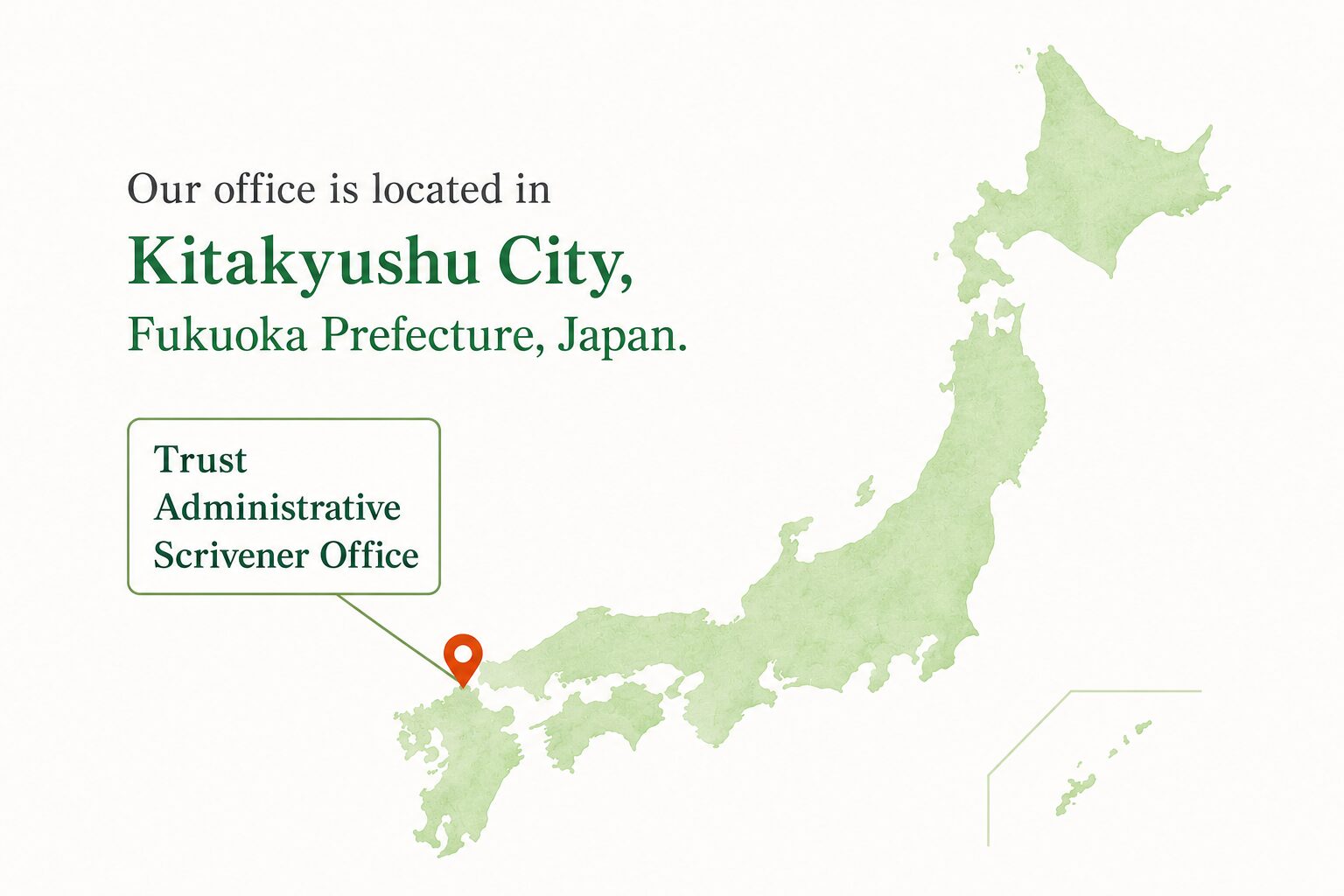
Trust Administrative Scrivener Office
Based in Kitakyushu, Fukuoka, Japan | Online consultations available